 Dana O'Driscoll
There are so many ways to honor the Awen as a druid–the spark of inspiration, the flow of ideas, and continuing to pursue a project that must make its way into the world. We all experience it at some point: it is the story or character who won’t let you go, the painting or song that takes on a life of its own, the dance that just flows out of us. And most importantly, honoring the awen is following the burning desire to simply work on a project and see it through to completion. Sometimes, you can feel the hands of the ancestors guiding you as you create. As a committed bard, I’ve experienced this on many occasions, but perhaps none so strongly as I have with the project I’ll share today.
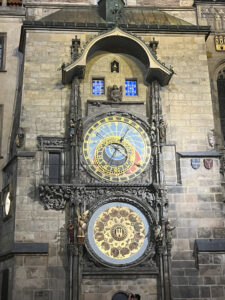
I have had the blessing of visiting the Czech Republic several times for my work in recent years (long-term readers might recall my describing experiences there visiting a mountain god a few years back). In my last visit back in September, I spent most of my time in Prague, which is truly one of the most beautiful and magical cities in the world. While Prague has a rich history spanning centuries, it was under the protection and guidance of Holy Roman Emperor Rudolf II, in the late 1500’s and early 1600’s that the city became a center for learning, expansion, and occultism. Emperor Rudolf invited and protected people like famed Tycho Brahe, Jon Dee, Edward Kelly, and Johannes Kepler so that they could continue their research into astronomy, astrology, alchemy, and more. In the Middle Ages and early Renaissance, alchemists were often brought up on charges of heresy or necromancy by the Catholic Church, forcing them to hide their activities. But Emperor Rudolf himself was fascinated by alchemy and protected them, inviting them to set up labs throughout the city. Important for our purposes today, Emperor Rodolf II was also a committed patron of the arts–he invited many famous artists to Prague and had the city adorned with beautiful paintings, statues, and motifs. Artists in Prague during his reign were elevated, and the Emperor routinely visited their guilds and workspace. He also owned a massive collection of artwork. This legacy can still be felt in Prague today–the city is full of magnificent artwork unlike anywhere else in the world.
It is at the center of this astrological, alchemical, and artistic golden age that a secret alchemy lab–now known as “Speculum Alchemiae“ or the “Museum of Alchemy” was in use. The alchemy lab, hidden in at least two sub-floors in the basement of one of the oldest houses in Prague, was uncovered intact but flooded in 2002 after being hidden for centuries. The lab has tunnels leading the Prague Old Town Square (where the Astronomical clock resides), and to the Prague Castle. This means that it is likely the Emperor also visited this lab and, perhaps, even engaged in some of the great work himself! After cleanup and restoration efforts, the Speculum Alchemiae is open to visitors and is recognized as a UNESCO World Heritage site.
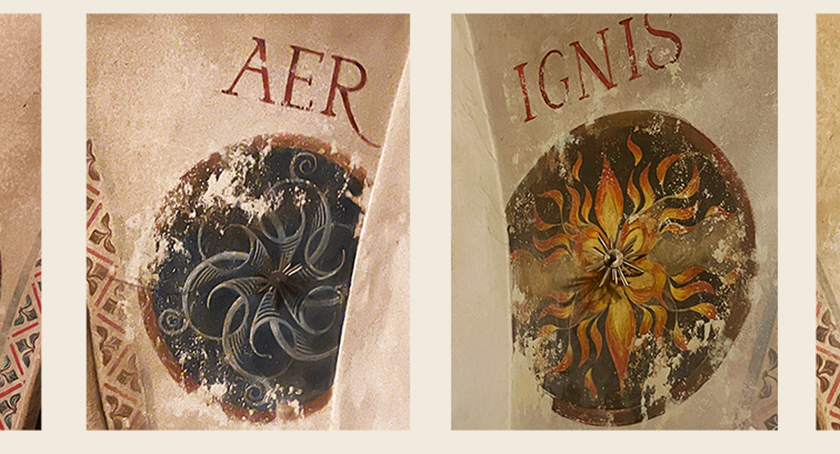
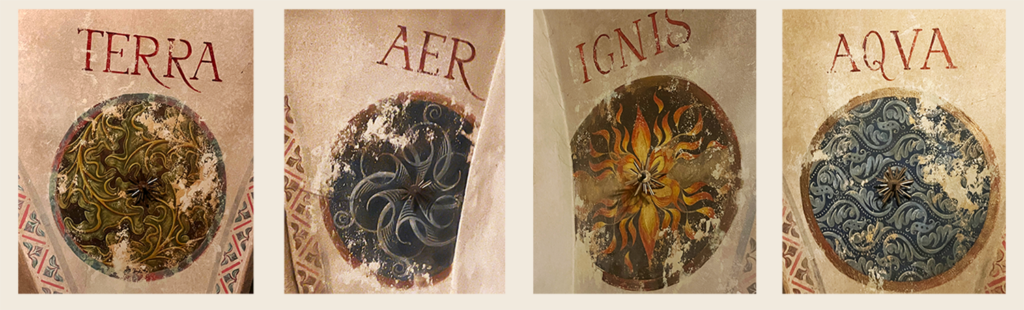
When I visited Speculum Alchemiae in September, I was enchanted by a set of elemental symbols that were painted on the walls of the study on the 1st floor. This study has a secret passage, hidden behind a bookcase, which leads down into the labs below. Adorning the walls of the study were these four incredibly ornate and unique alchemical symbols. I asked about them on the tour, and I was told they were the original symbols and that they had peeled away layers of paint to find them. These symbols were unlike any other elemental symbols I had ever seen, and I took many photos with the hopes I might study them further. In today’s post, I’m going to take you on an ancestral and bardic journey of recreating these symbols and my beliefs about their meanings. I’ll show you around the lab first before we get into the bardic project itself.
The Museum of Alchemy


Since there is lots to see, I’ve uploaded them to a gallery–above in this post–, and you can scroll through and read the story of my visit to the Museum of Alchemy. Speculum Alchemiae is only about a 10-minute walk from Old Town Square, right on the edge of the Jewish Quarter of the city, in the heart of Prague. The tour begins in the museum shop, where they have hand-blown glass bottles of actual recipes formulated by the alchemists of the 15th century. As you went inside for the tour, you came to a study. On one of the shelves in a little glass box is an original 15th-century potion that survived the floods–they don’t know what is in it, but it sits on display on the ceiling-to-wall bookshelf. Like everywhere else in Prague, the room is richly decorated with elaborate paintings, and what immediately drew my eye were unique elemental symbols in the four directions on the walls of the room. Woven into the arches themselves, the names of the elements in Latin, the elements provide what I believe to be an alchemical framing of the work before you enter the secret passage and descend into the labs below.
A statue in the bookcase is actually the handle to open up a secret door with a spiral stone chamber leading down into the depths–where the alchemy labs were. In these stone tunnels and rooms, you first come to the traditional alchemy lab (for working with metals and chemicals). You then move to the spagyrics lab for working with plant alchemy. Both of these rooms had large furnaces to keep all of the preparations warm as they brewed, and they are quite large, being likely able to hold a half dozen or more alchemists comfortably. In addition, there were rooms for drying herbs, for storage, and a room for glass blowing. Glass blowing was a necessary skill as an alchemist, as you needed to create the various alembics, bottles, and tools to use for the great work. There were other rooms too–and a whole other floor–which our tour guide told us were still underwater based on the current height of the Vtalva river.
Our guide showed us the locations of the secret tunnels locked behind iron doors–some of them since collapsed, but some lead far into the city. This space was not a small affair–it was clear it was a focal point of the great work and formed an underground network of potentially other labs or occult activity. And speaking of that great work, I could feel the energy of this place lying solid in the stone of the walls. The focus, the practice, the dedication of the alchemists in turning dross into gold, in doing both the outer work of transformation and the inner work. I felt that energy seeping into my blood and bones, inspiring me for my own great work. It was a pretty incredible experience.
When we returned from the secret chambers and back up into the study, the Awen continued to flow through me, and I stood in the room and simply felt the presence of these ancient elemental symbols on the walls. I felt them calling to me, and I became very deeply inspired to recreate these symbols. They were in remarkably good condition for being 500 years old, but time and age had caused some damage, and parts of the symbols were worn off, chipped off, and faded. I was intent on recreating these symbols and learning more about the elements through my own bardic great work. I truly had no idea what I was getting myself into, or how challenging the project would be!
Recreating Speculum Alchaemae’s Elemental Symbols
I took photos of the four elemental symbols as best I could while I was there, but the lighting was dim, and my cell phone camera was all I had to capture the images. For this work trip, I brought my parents (who could vacation while I worked). They are retired professional artists, so we talked through the images while we were still in Prague, discussing traditional techniques, geometry, and pigments. We had time to study other buildings, and my parents, with their strong background in art history, were able to provide much insight not only on my symbols, but also to study other older interior paintings on plaster to get a sense of the techniques of the time period.
The Magic and Magical Container for the Work
Having the spark of inspiration from the ancient alchemists themselves, I began the project as a magical act. I set up my Awen altar, and opened up a sacred space specifically for the work. As I have done with previous long-term projects, I keep that space open in my art studio for the duration of the project. For this, I use a version of AODA’s Sphere of Protection ritual, setting intentions towards a long-term magical art project. Since my studio is a dedicated magical and artistic space, this approach works well for me and allows me to hold a “container” for longer-term work. (I also do this for other kinds of projects with medium to long durations; it helps keep the energy contained, keeps me focused, and allows me to carry the energy forward with each session I work on the piece).
I started the project in earnest during my winter break and January retreat–which was a good time to deeply dig in. I felt like, at times, this project completely took over my days, where I would spend hours tracing lines, working the compass, or researching traditional pigments for the 15th century to understand what to work with to recreate the images.
As part of my magical foundations of the work, I invoked the ancestors of both alchemy (as I practice spagyric alchemy myself) and of the bardic arts, asking them for their inspiration. At the start of each session, I would take my Oak spagyric tincture, which I recently completed using ancient Druid timing and spagyric alchemy techniques. I would take time to invoke the Awen and meditate on the original symbols before beginning.
Early in the journey, the artist himself showed up in spirit to work with me through the process, which was a true blessing upon the work. In addition to getting to know him, which was amazing in and of itself, I was able to heed his wisdom in a few key areas, which helped produce a better result. For example, I during painting, I kept mixing up small batches in paint, which led to slight color variations. He had me mix up much larger batches, which allowed me to go over everything again to create a consistent color. During this process and my retreat, I also crafted an Awen/Creativity/Flow incense, which I left on the altar as it dried, and then, after a week of drying, burned it when I worked.
Each time I went to work on the art, I would take a moment at my Awen altar, invoking the ancestors, chanting the awen, anointing my forehead, connecting with the tools. Then I would continue the project. I couldn’t make any other art during this project–the project consumed my artistic time and flowed from me until it was completed.
(I share all of these details for other bardic practitioners, who might take any of the above and adapt it to their own purposes!)
The Line Art
I first took all of my photos into Adobe Photoshop and attempted to compile the images together as a starting point. This quickly led to frustration, as to be honest, I’m not much of a digital artist. I abandoned this approach in favor of printing them as large as my printer would allow. Then I taped chunks of the different images together to form a complete picture. Then I spent a lot of time working on recreating the damaged areas–filling in what was damaged by age using gouache, India ink, pens, and markers. This initial step helped me to recreate the images as they would have been drawn.
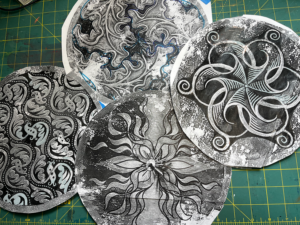
The photo above represents this first step. I now had a basic drawing based on the photos. I then I traced these drawings onto tracing paper (below)–and continued to work on the sketches until I was satisfied. I also did some ruler and compass work (as the artist certainly would have done) as all of the images I had were slightly skewed by the angles on the walls. This allowed me to ensure everyting was in aligment.
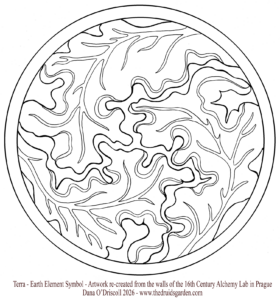
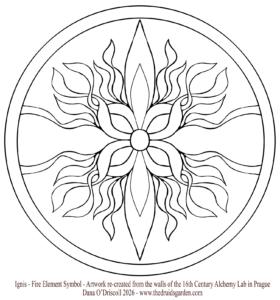
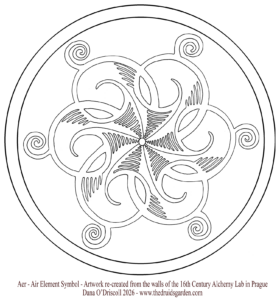
The other challenge is that in the center of the images was something I learned was called a “metal boss”–I believe that this represented the element of spirit. Beautiful gilded metal stars, circles, and halos are found throughout the city adoring artwork. These would have certainly been gilded in gold at the time. I had to recreate the art that would have been under these (and I plan on exploring these with some help from a friend who does metalwork in the future).
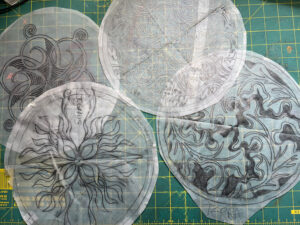
Finally, when I felt the images looked as close as I could get them, I traced them onto Bristol paper and proceeded to create black-and-white line art. The line art was important to my process because it allowed me to step back and really look at the images and make sure I didn’t have any mistakes or issues.
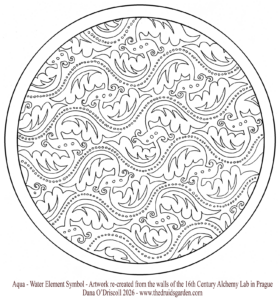
Below is the line art. Now you can start to see the symbols as well as their numerology:Terra / Earth Three; Ignis / Fire / Four; Aer / Air / Six; and Aqua / Water/ Many. This progression and numberology is actually part of the magic of these symbols (and I’ll talk about that more in my next article).
The Pigments
With the line art created, my next step was to figure out how to recreate the actual artwork. Given the age of the paintings, the damage, and the poor lighting, I did not want to depend on the photos themselves to match the colors. I decided to recreate the images with what would have been available pigments in 15th century.
First – what kind of paint did they likely use? Egg tempera (a combination of pigment and egg yolk) would have most likely been used in that time period. I have not used egg tempera at all, although I do have some supplies here to create this paint. After doing some additional research and testing out both Egg Tempera and Gouache, I settled on Gouache (opaque watercolor) for a close approximation and look. I have a lot of experience with Gouache and knew I could produce a nice painting at my current skill level and use traditional pigments–available in gouache–to do so.
Artists of the 21st century are quite spoiled with readily available pigments and paints that are quite reasonably priced and widely accessible. In the 1500’s, however, pigments were more costly than gold, and painters of those days had very limited color selections. The finest pigments could be worth a year’s wages, and for some, like blue, there were expensive and cheap options Since the alchemists had the support of Emperor Rudolf II, I suspected they had funds for higher quality pigments, and I went with that assumption as I did research. In my description below, I offer an overview of the pigments themselves as well as the pigment number, which is used in higher-end paints to describe the chemical composition of the pigment. In terms of brands, I used M. Graham and Daniel Smith for most pigments, with Terra Verte coming from Holbein’s line.
Here is an image of my final palettes for the paintings, along with the pigments I used. I used a total of 7 pigments; air and water shared a palette as they were made up of the same colors. I like to show the palettes so you can also see the mixing process. As I began to mix my first batch of paint, the spirit of the artist himself came and gave me some very useful tips about brush strokes as well as pre-mixing much larger batches of paint to ensure precise color matching. This is why in the palette photo above, you see little paint cups with labels–those are the pre-mixed colors for the air and water images. I saved myself a great deal of trouble with his advice.
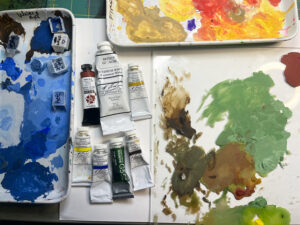
Outer edge: It is likely that the outer edges of the paintings may have been gilded (in gold leaf) with an underlayer of this red-brown. But there were many other colors on the outer edges too, so I chose the pigment based on what was most visible in the wall paintings. For this, I used:
- Indian Red – this is a very old pigment (PR 101) that is derived from iron oxide. This pigment stretches into human prehistory, with iron oxides being painted on cave walls and representing some of the oldest human art on the planet. I chose this color for the outer edges. The outer edges in the originals clearly had a number of different colors painted over time, and likely were also gilded in gold leaf, but the clearest color looked to be this. I may experiment with gilding the edges in the future on my original artwork.
Air/Water Palatte: These two paintings have only two colors:
- Ultramarine blue (PB29). This is traditionally made of crushed Lapis Lazuli, although modern pigments are synthetic. Ultramarine Blue represents one of the most expensive of the colors in this set of seven. Ultramarine blue pigment was often used on the vestments of saints and god figures in the Middle Ages due to its worth and value. Thus, you see this color very often in paintings of this time period. Now, for this shade there are two options: the belief Lapis Lazuli drived Ultramarine Blue (very costly) and Azurite blue, which was a cheaper and less vibrant alternative. Since the Emperor himself was involved, I made the assumption that they would have had the funds for the Ultramarin, especially as it was a small area to paint.
- Titanium White – the traditional color of the period would have been lead white, which I substituted for Titanium white due to obvious health concerns.
Fire/Earth Palette: These two paintings use five colors. These first three are shared between the two:
- Indian Red – PR 101, as above.
- Raw Umber – Another iron oxide/earth pigment with a long history (PBr 7).
- Yello Ochre – Yet another iron oxide/earth pigment with a long history of use. (PY 43). This is a deeper shade of yellow that you see on the veins in the earth painting, for example, and in some of the lightning bolts in the fire painting (the darker shade).
Fire only: The bright yellow in the fire image would have likely been Orpiment (Arsenic Sulfide). This is especially likely as the alchemists themselves worked with Arsenic and using this color would be aligned with their work. However, it is unsafe and illegal to paint with Orpiment. I substituted a modern color called Hansa Yellow (PY3), which is a close approximation of the hue.
Earth Only: This is the earthy green pigment found in the leaves of the Earth element painting. For this I used Terra Verte (PG 17, 23), another earth-derived pigment (PG 17, 23) with a long history.
These pigments–with my two substitutions–constitute seven total colors for the four paintings. This palette would represent quite a large and expensive palette for an artist of the 15th century. And to this day, a foundational skill in painting is working with a limited palette and mixing different colors. All artists used to have this skill, and this is part of why many of us who are serious about painting in any media train with a very limited palette–so that we know how to mix every color possible with a small number of pigments. There’s a great creativity and joy in that–and while it is an “option” today, it is still a skill that many of us hone. I’m grateful for the lifetime of lessons my parents instilled in me in working with a limited paint palette since the age of six. That’s the ancestral way.
The Painting Process
I worked on the paintings themselves for about a month, and the work was very detailed and precise. I was very grateful for recently completing my certificate in Botanical Illustration, which taught me how to slow down and really dig into the details of the work, and expanded my painting skills with a limited palette. I needed my full range of artistic skills to pull off these paintings.
But all of that focus was a form of meditation that also slowed me down, get into a flow state, and allowed me to deeply connect with the paintings and the elemental energy behind the paintings themselves. As I was creating the work, I felt the power of each element rising within me, shaping me as I shaped the work. I also began to experience the manifestation of the numerology present in these elements. My other magical work was shaped by the painting process, and I often found these symbols coming into my dreams, meditations, and other inner work. As I worked with each of the elements, I could feel the hands of the original artist guiding me and the power of those elements channeling through me.
During this process, I remembered one of the most fundamental teachings of my mother: “look more than you draw.” I always had the original images up on my computer while I painted, checking each detail and making sure that I was depicting each brush stroke just as the artist would have done so. Often when I started a session, I would simply sit with the original painting, observing the details carefully for 5-10 minutes in meditation before mixing any paint. This was helpful and was a way of embedding myself back in the work.
I worked days and evenings, sometimes late into the evenings, continuing to allow these paintings to unfold.
And then, every so slowly, the paintings were complete! I felt like I was coming up out of a six-week trance where I was either working on the project or thinking about the project when I couldn’t work on it. And then, like that, they were finished. And they were good.
Completed Work
Here are the completed paintings (you can click on them for a larger image).
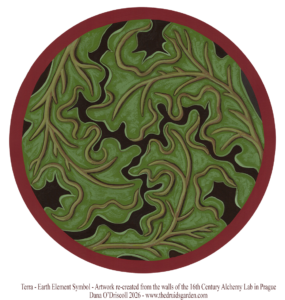
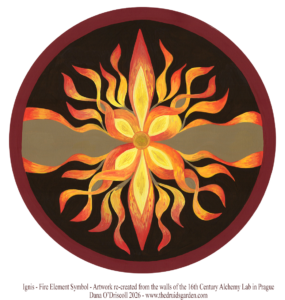
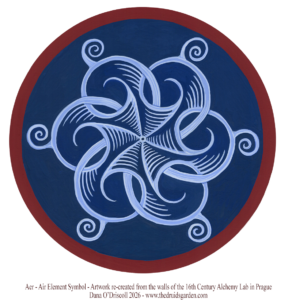
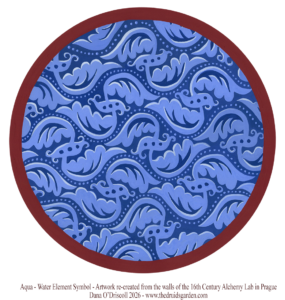
And here is a compilation of the images and original photos.
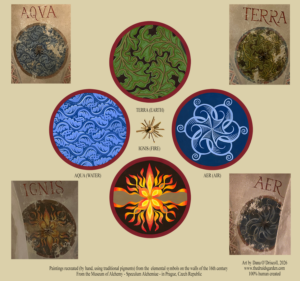
The project is done for now, but this summer, I would like to explore the other two elements of this–creating the metal “boss” found in the center of each of these (which will be another deep dive in a completely different direction), and potentially completing the gold leafing on the outer edges. These two wouldn’t scan well, so these would just be for me :).
The Insights: Representing the Nature of the Elements
When you search for an image of the elements today, you see the same symbols over and over again–the triangles and lines, most commonly. And herein lies one of my major insights into the project: while elements are certainly an archetype and magical language of themselves, one of my big takeaways from this project is that we do not represent them well with our present set of triangles and lines. While parts and principles from our present elemental symbols in common use can be traced back to antiquity, the present “flat” images became codified in their present form and taught through occult teaching schools of the 19th and 20th centuries. There’s magic in these simple symbols, too – for example, the horizontal lines were likely added in the 18th century to represent the passive vs. active principle–but compared to these older elemental symbols, there is a richness that is lost.
But what exactly do these 15th-century alchemical symbols mean, and how do they convey something deeper? As I’ve been painting, I’ve also been reading and studying, and I believe that these symbols aren’t just simple picture but teach core aspects of both elemental cosmology. Since this post is already above 4000 words, in my next post, I will write more broadly about how these symbols offer deep teachings on the nature of the elements and speak more broadly about the power of symbols like these as teaching tools to help us understand cosmology, the nature of the elements, and core practices within alchemy.
Thanks for joining me on this journey into ancestral and bardic wisdom. I hope you found it interesting and enlightening!


This was wonderful. Thank you for sharing your process. Beautiful!
Thank you, Lynn!
Absolutely breathtaking Dana. Your dedication is present in every bit. Truly humbling to see. Thank you for sharing.
Thank you 🙂
I’m in awe of the images and your dedication to the process of allowing them to manifest in this time and offer their teaching to us. Very much looking forward to your next post!
Thank you so much, Claire! :). This means a lot coming from you!
WOW! Just WOW!
Thank you! 🙂
I love the re-creation of the symbols, and the insight on all you experienced. We loved the time you treated us to in Prague!
Thank you for all of your help with the symbols! 🙂
Oooo! Those are GORGEOUS! Thank you so much for sharing.
Thank you! 🙂
I think it’s interesting that we use yellow to represent air, when it appears that these fellows used blue for air and water. That’s a rabbit hole I might have to go down myself.
Hi Kara! Thanks for the comment–I was wondering the same thing! I have two thoughts: the first is that it could have been intentional (e.g. the sky is full of blue and white patterns, not so much yellow except at sunrise/sunset). But I also wonder about the availability of the pigments. Although there is no reason the symbol couldn’t have been painted in more common yellow oxide! It is certainly a useful rabbit hole to go down!
I think that yellow for air comes from the Golden Dawn, although it’s been years since I went down that rabbit hole.
It’s really intriguing that the same colors are used for Air and Water. It makes me wonder if they were stating the similarity between Air and Water. Both are fluids and experience a lot of the same dynamics of motion. How wonderful it would be to have a time machine and eavesdrop on some of these alchemists’ conversations.
Thank you for sharing both the product and the process. Your photos from the Speculum Alchemiae are so interesting and I really enjoyed reading about how you followed the Awen every step of the way (inspiration, exploration, frustration, dedication, creation, reflection, etc.). Good luck with the metal boss and gold leaf!
Thank you, Rachel! It has been a wonderful and fun process :).