
 Dana O'Driscoll
In my last post, I shared my magical bardic process for recreating the four elemental symbols that I photographed from the Museum of Alchemy, Speculum Alchemiae. This week, I wanted to step back to explore how we understand and symbolize the elements in modern practice, tracing their history, and comparing the classic symbols to these alchemical elemental symbols I just recreated. This will help me illustrate the broader point about the role of symbols as blueprints to reality as well as a magnificent ancestral legacy that we may not even realize.
One of the reasons I’m taking the time to do this today is that in my current role as the Grand Archdruid of the Ancient Order of Druids in America, I mentor a lot of people new to the tradition, and I answer lots of questions. As new people are learning about how AODA does things, with our emphasis on the seven elements, specific symbols, and ritual structures, we often get a lot of questions about where these things come from or if they can be modified or completely changed. Those new to any kind of nature spirituality may not realize the long history or value in such classic symbolism–and so, what it is and how it has come to be is useful to explore as part of our own ancestral legacy. IAnd the truth is, I have been researching elemental symbols for some time to try to trace AODA’s own unique elemental symbolism. So this post naturally has come from a few places, and I hope you enjoy it!
Elemental Symbols and Ancient Roots
Most of us in the West use a set of elemental symbols, but we may not recognize how old these symbols are or how they were handed down to us throughout antiquity. In fact, the common triangle and line symbols of the elements, for example, have their origins in Ancient Greek philosophy, although they did not use these specific symbols. Here is an example of these ancient symbols in my modern interpretation, using colors, plants, moon phases…and the classic symbols themselves: triangles and lines.
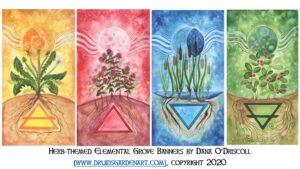
The Ancient Greeks saw the four elements as being tied to the roots of all existence (with the 5th element, Aether, being tied to spirit). They mapped the elements onto sacred geometrical shapes (triangle = fire; square = earth; octahedron/8 sided = Air, isocrahedron = water). They were also mapped onto qualities, which are still used in the traditional Western Herbalism becuase it is a useful, simple, and robust cystem: fire (hot/dry); air (hot/wet); water (cold/wet); earth (cold/dry), which are tied to the four humours and also the states of tissues in the body. In fact, this elemental system is quite robust and can map onto anything from medicine to physics to alchemy.
What is really fascinating is that different cultures throughout the world came to similar conclusions about the nature of these five elements and even, in some cases, came to similar unrestandings their symbolic structure. While some of this crossover may be ancient cross-cultural influence, it is hard to account for that in the robustness and similarity of these ancient systems.
For example, in India, earth was often represented by a square, fire by a triangle, water by a crescent, air by a hexagram, and aether by a circle (not very dissimilar at all to the Ancient Greeks). These symbols were also tied to the chakras, mantras, and chants–among many other things. In China, we see five elements – wood, fire, earth, metal, and water, which were also tied to animals, colors, characters, and directions. Some native Americn cultures likewise identified four directions, which were tied to symbols, seasons, animals, and directions, allowing them to map everything into the wheel. What we can see is that despite great geographical distances, many cultures around the world developed surprisingly similar systems focusing on a set of four or five elements–and in some cases, even used similar symbols, directions, and principles. One takeaway from this information is that when we connect with these elemental symbols, we are connecting with something deeply universal, how humans map these patterns onto the world.
By the late Middle Ages and Early Renaissance, both in the Islamic and European alchemical traditions, the four classic symbols as we know today were being used regularly, along with a set of other symbols representing the heavens, planets, and alchemical operations. The modern elemental symbols were essentially originally an alchemist’s shorthand, able to be easily scribed by hand in their journals and books. For example, below is an image of an alchemical table from German Alchemist Basil Valentine’s The Last Will and Testament from 1670. A close look shows all of the traditional symbols for aqua (water), terra (earth), ignis (fire), and aer (air), along with modified symbols for various operations tied to those elements. You can see how a simple triangle or a triangle with a line fits the overall vibe of the alchemists’ documentation system.

These symbols that the alchemists used have some fairly clear underlying logic: the upward motion of air and fire represent the “active” principle, while the downward motion of the earth and water represent the “passive” principle. Water and fire are opposites (both just in triangle form), while earth and air are opposites, and both have lines. The lines could represent some kind of constraint or materialization, where water and fire, pure elements, earth and air are modified by them (e.g. air moves because of heat and moisture). There are other interpretations of the symbols and lines, but what I’ve described is a fairly common one.
By the 19th and 20th centuries, many different occult movements adopted used these symbols heavily. They likely came into mainstream occultism today by way of Rosicrucianism, which rose in the 17th century, and into Golden Dawn in the late 19th and into the 20th century. These traditions were both heavily influenced by previous occult and alchemical work of the west. And, of course, nmany current esoteric movements and orders continue to be influenced by the Golden Dawn–for example, in AODA, our 3rd Grand Archdruid, Dr. Juliet Ashley, was not only the head of AODA between 1952-1974, but she also started the Holy Order of the Golden Dawn in Philadelphia. She obtained a charter from Edward Waite in 1939 for this purpose, and she is one of several leaders of the order (including myself) who have practiced Golden Dawn in some form.
These same kinds of connections can likely be traced in many different druid orders or other pagan traditions and all root back to the same intellectual, philosophical, and magical origins. And of course, AODA uses a version of these symbols (with some differences).
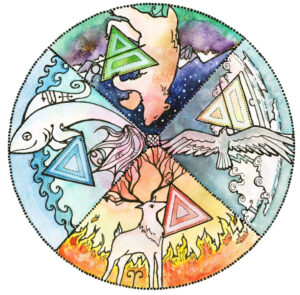
Like many others, I have worked with these symbols extensively in my own art, ritual practice, meditation, and more. Like many, I worked with them for years before I even thought to delve into what they really represented or where they came from. That’s part of their power–you don’t need to know where they came from, but it is clear that they work. These traditional elemental symbols have great value as a shared language, holding the energy of the elements powerfully, passed down through so many humans across time as a shorthand for a larger cosmological understanding of the world. Symbols possess their own egregore and their own spirit, and each time you trace one of them, you are tapping into that ancestral legacy.
But there’s a part of me that wonders about how else these elements might be represented? What other stories could different symbols of the elements tell? How we choose to represent the world has a deep impact on how we view and understand reality. The symbols themselves, the languages that we use to describe them, even the way that the words form in our mouths–all help shape our reality. One of the things I like to think about is–what if we represented the world symbolically in a different manner?
The Alchemist’s Antechamber: Elemental Symbols that Offer a Different Angle
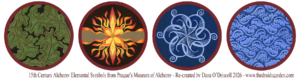
I’ve been thinking a lot about representation as I’ve delved deeply into my project to re-create the elemental symbols at the Museum of Alchemy. They represent something related and yet different. A different variation of the same larger system of Western thinking from antiquity.
Let’s first look at the symbols and their movement. I learned a lot in just painting these symbols, following their strokes and movement. Consider the the more traditional symbol of fire (a triangle, usually red, facing upward) compared to the Ignis symbol from the Alchemy lab. The simple triangle shows no movement or energy of fire. The Ignis symbol –with its dynamism, the smoke, and even something that looks a lot like lightning bolts, are all tied into a beautiful fourfold mandala. You learn about fire by seeing this more complex representation–how the fire twists and turns, and how it moves, the different aspects of lightning, smoke, and heat. Even if you never experienced an actual open flame, this image captures fire so beautifully and magically. This symbol represents more of the reality of fire, not just its abstract representation. A second example, the same can be true of Air / Aer – the air symbol is moving in all directions at once, you aren’t just getting forward movement, you are getting spirals, and it is going back on itself. When you burn incense or observe smoke, you can see this same kind of spiral pattern in the air–the air moving in and spiraling around itself. This is really different than an upward triangle with a line. There is something more tangible about these symbols.
Each of these pieces of art is a mandala–the threefold earth, the fourfold fire, the sixfold (or 12-fold) pattern of air, the wave/many pattern of water, and. When you meditate on these symbols, you can feel the movement of them and feel the energies of the element represented in a magical form. I believe they are meant to represent deep teaching tools and a symbolic logic about the world.
That brings me to numberology and ancient cosmological understandings of the cosmos–what did these represent to the alchemists? In terms of the numberology of the symbols, at first, I thought they could be tied to the Platonic solids as described by the ancient Greeks. Here’s an example of Kepler’s assigning of geometric forms to the elements–and Kepler was right there in Prague at the same time these elements were likely being painted on the walls of the study.
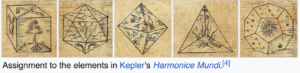
This pattern maps beautifully onto air, as Air isconnected to the octahedron (the eight-sided structure with six points). The pattern also seems to fit for Water–the 20-sided isocrahedron–as there are about 20 objects in the water pattern if you count all of the ones partially shown.
But what exactly is going on with the inversion of earth and fire? Why is fire showing up as four and earth showing up as three?
Symbolism as the Alchemical Process
The answer, I believe, lies in the great work itself. I now believe that these symbols represent the alchemical operation through numberology. One becomes three—spirit given form into matter. Three becomes four—matter into deeper manifestation and transformation, the alchemical fire. Four becomes six – manifestation radiates into expansion and possibility, and then finally, six becomes many, and as they expand, all is dissolved to reform again with the one. So let’s walk through this pattern:
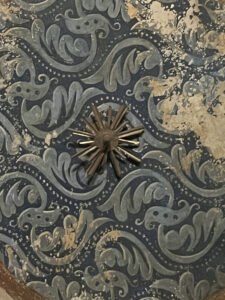
One –Aether – The photo above depicts the original water painting with what is called a “metal boss” in the middle. This star-like feature is in the center of all four elements in the study. In fact, metal ornaments like these–always gilt in gold–are found all through the city: on the tops of spires, on the halos of the saints, and in the center of these alchemical symbols. In observing these throughout Prague, I believe that this represents the source of all, the representation of aether. Likely, this little ornament in the center of these would have been gilded with gold leaf back in the 15th century, and you can see clear eminations coming out in all directions. Metal as a whole in alchemy is fixed, conducive, and transformable. Gold is, of course, the alchemist’s idea of perfection–one of the major aims of the great work was to transmute metal into gold.
The fact that the Alchemy lab is in the Jewish quarter of the city also might connect this to the philosophy present in Kabbalistic thought, including the connection of the one to the many and the idea of one emanating outward from the center.
The center point is tied to aether/spirit, which is present in all things and in all elements.
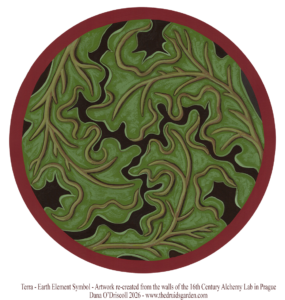
Three – Earth – Form/Shape/Stabilization. Now we move to earth–the smallest number represented in the four elemental paintings. In this view, Earth is the emergence of form. Three offers grounding and stability. Two represents an opposition and unbalanced polarity, while three brings balance and structure. Think of this like legs on a stool–with two, you’d fall over, but with three, you are stabilized (this is also why binary thinking is so problematic, and it is useful to consider a third perspective). We see the oak leaves depicted, representing earth as a living thing rather than just an abstraction. With the inclusion of plant matter, it may also be a nod to spagryic (plant) alchemy, as we know how potent a tincture one can make from many plants–including acorns from oak trees. Oak is a tree linked to many sacred peoples and times, including a variety of thunder gods– Zeus, Tarani,s and Jupiter.
This symbol, with its threefold pattern, represents the stability and matter given form.
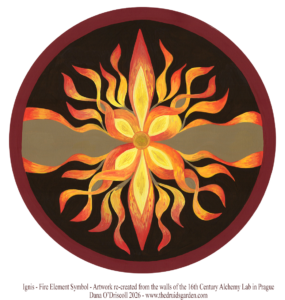
Four – Fire – Action/Manifestation/Power/Transformation. Fire is a transforming and radiating force, manifesting activity in the world. And here we see the mandala, the four-fold pattern of manifestation into the world. Four represents actualization of our thinking and actions, crystalization, the idea of bringing forth into the world. That is a transformative process.
The choice of a mandala here is also representative of the four forms of fire itself: the flame, the coal, the ash, and the smoke.
Fire is the great transformer, burning dross to gold.
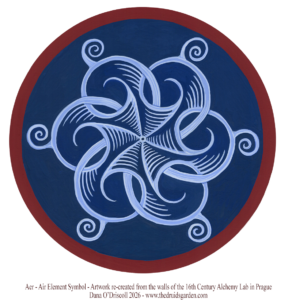
Six – Air – Circulation/Connection/Movement/Expansion. The six-fold pattern of air is all about movement, directions, and building deeper relationships. The ancients saw Air as a mediating element between the other elements–bringing the others together. I think that’s happening here in this artist’s rendition too–air is bending out and going in on itself, the entire image a continual force of movement in all directions at once.
The six-pointed octahedron, upon which Air is connected as a Platonic solid, represents movement, refinement, and expansion. Air is the greatest pinnacle of what humans make possiboe.
Air represents movement, refinement, and expansion beyond what has already been created. Things at their highest elevation and greatest good.
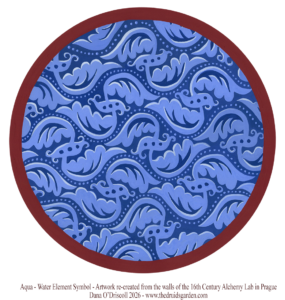
Water – Many- Dissolution / Separation / Returning / Flowing / Reception. This image of water, with its “many” number, focuses on taking the expansion of Air and dissolving it to bring things to the beginning of the cycle again. This is dissolution, separating things into multiple possibilities, creating a clean slate for new work to emerge. Arabic alchemy preserved the ancient Greek texts during Europe’s dark ages, and also greatly expanded those texts–Arabic alchemical texts often describe water as being something that receives all forms and which dissolves any distinctions. Arabic alchemy, which was obviously very influential on Europe throughout the Renaissance, would have had a significant impact on what was happening in 15th century Prague.
Water is the great dissolver, breaking down and creating a clean slate to begin the cycle again.
Conclusion: Symbols as Maps of the World
So there they are–both the classical symbols and this very interesting interpretation of the elements from Speculum Alchemiae in Prague. I’m glad that these symbols, hidden in Prague for centuries, have now made their way into the world once again. They have much to teach us, and my interpretation above may be only one of many teachings and lessons they offer.
As an animist, I recognize that all things have spirit–and these symbols will grow and evolve as they are brought back into the world. They will be used in their own way, and they belong to all of us. I hope you enjoy meditating upon them and seeing what wisdom they offer you–and please share, as I’m curious about others’ interpretations.
It is pretty amazing to think about the stories that are present in the symbols we use daily–these symbols have their own spirits, their own energy, and their own incredibly rich histories. When you trace a symbol in the air, or you draw that symbol in a magical working or bardic creation, you are tapping into an incredibly rich and magical tradition of human wisdom that has been handed to us throughout the age. We honor the ancestors in so many ways, and it is good to remember how deeply they connect to us through what they have left behind.



You said you were curious about others’ interpretations…
Fire is One (the center) to Two (the horizontal axes) (and then another Two, the vertical axes) to Four (with the ‘cross quarter’ flames being a blend of the horizontal and vertical axes.
The Water contains a Unity and a Trinity, with some swirls going clockwise and some counterclockwise, because things can dissolve in water and things can coagulate in it and precipitate out.
Six is a perfect number (it is equal to the sum of its divisors, 1+2+3 = 6). It is also the product of its divisors (1 x 2 x 3 = 6). Iamblichus said six represented marriage, the product of the first male and female number (2×3) and was therefore the maker of souls. Air is the ‘marriage’ of Fire and Water. And different traditions describe ‘soul’ and ‘spirit’ differently, but I can easily see how the Divine Breath relates to Soul.
For Earth, when I first looked at the image, I didn’t see oak leaves. I saw landforms with drainage patterns. In Greek mythology, Zeus, Poseidon, and Hades each rules a different domain (the supraconscious, the subconscious, and the unconscious), but they shared the Earth (the conscious).
Thank you so much for sharing the images and your thoughts on them. I’ve been enjoying this series of posts.
Hi Karma,
Thank you for your insights! These are great and are helping me see things even deeper!!! I didn’t see land forms at all with earth, but now you mention it, it is clearly there! I love your deep insights on water and fire. These are beautiful interpretations–and glad you are enjoying this series.
I’m a little obsessed with these symbols. They’re incredibly beautiful and compelling. Through your renditions I feel as if I’m having a conversation with the mind(s) behind them.
Hi Anna, I’m so glad to hear from you–I’m also a little more than obsessed with these symbols. They have a strong spirit and a life of their own. I’m so glad you are speaking to them. This was my experience too–I was having an ongoing conversation with them, their creators, the elements, the energy, the numerology–glad they are resonating!
Also, the tips of some of the Fire flames remind me of the “yods” that Pamela Colman Smith painted in her tarot depictions.