 Dana O'Driscoll
 At the beginning of January, I always do a 10-day spiritual retreat. It is rarely hard to go into retreat, but it is always difficult to come out. Coming out of any retreat can be challenging to re-align with the insane pace of the present modern-day human world, to go back into human communities that are fundamentally broken and out of balance. I always have some difficulty in getting my bearings again. But exiting from this retreat on January 11th was particularly jarring and awful–watching my country fall further into crisis, darkness, and death. I’m not going to talk about that today, because honestly, everyone is talking about it everywhere and I will continue to write these blog posts as symbols of hope, enchantment, and building the world we want to see. But I do want to take time here to acknowledge two things: 1) the world is in crisis right now, and it is hard on all of us. Spiritual practices, creative practices, time in nature, and spending time in community are balms to all of our weary souls. And 2) like most others, what is happening right now in the US is deeply and personally impacting me. I will work to maintain my every-other-week blog post schedule in 2026, but I might miss a few here and there because I find it hard to focus sometimes with everything that is going on. With that–druid retreat and lessons about time, lighting, and the ancestors.
I often use my retreats not only to do deep spiritual and creative work, but also to heal, re-align, and remember. Today, I want to share some of the insights I had from my retreat on awareness, the ancestors, lighting, and time. I’ve written a bit about druid retreats before – here’s how to set one up and some things you can do, and here’s a bit about going dark week, which is always part of my retreat. I also work on my oaken grimorie and spiritual journaling during this time. And yet, each retreat is different. Each retreat has its own energy and time. After the insanity of 2025, where I spent way to much time reading news articles and being online watching the collapse happen in real time, the theme of my retreat this year became shifting awareness into ancestral time and simply resting and resetting.
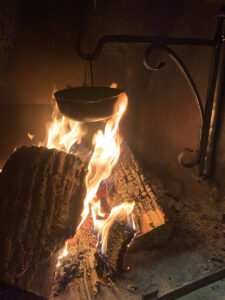
One of the things I do during my retreat is work to deeply align with the rhythm of nature–of the sun, moon, and land around me. To do this, I eliminate my use of technology, such as the phone, computer, etc, but also do a deep dive into other ancestral ways of living. I turn off the artificial lights and live by candlelight. I cover up the clocks, which then requires me to pay much closer attention to the position of the sun in the sky and to the sunrise and sunset. I put an altar cloth over the computer, and told the computer to take her own rest. I cook over the open flame, eating nourishing foods from our land and simple foods. And each time I do this–which I have been doing for over 10 years–I pay attention to what I experience as I do it. In my retreat a year ago, I actually had stress in switching things off, as I was almost going through withdrawal from the devices(which allowed me to re-align my relationship with them). This retreat I felt time slowing down and stretching out, my anxiety lessening, and my breath becoming more stable, and being relieved to let it all go. As this happens, I pay attention to what I miss about modern life, what I yearn for, and evaluate that relationship to decide if it’s healthy and nurturing or not. And this has led to some new thoughts about modern life, time, and lighting that I wanted to share today.
Modern vs. Ancestral Living
What I think we often forget as we go about our busy modern lives is how short a time period modern technologies are woven into every aspect of our existence–they haven’t been around that long. Artificial lighting, for example, is something that every person in developed nations, at least, experiences–and it was only a few hundred years ago that humanity lived entirely by candlelight at night. As I will describe in this post, we lose our sense of nature’s time when we have artificial lighting, and the lights never go out. Modern precise time (dare I say “artificial time”?) is another one of those modern things–we have devices, clocks, watches–time is so important that almost everyone in modern nations lives by the clock and carries one on their person. We are hyper aware of time, and yet, most of us are completely disconnected from nature’s time. It’s important to understand that humanity did not evolve with these things, and they are not natural, at least not in the way that our ancestors would understand.

But after this adjustment period of shifting away from modern time, lighting, and technology–something really powerful happens. You slow down. You breathe deeply, you shift your tasks, your awareness, your very being into something else, something older, something way more sane and balanced. Your body knows this pace. Your mind knows this pace. All of the other life on this planet knows this pace. It is the pace of your ancestors, the tens of thousands of generations of humans that walked the earth before you. Your anxiety lessens, your mind slows down. And you release yourself from the modern world and allow deeper awareness to flow through you, you recognize your ancestors perhaps always lived in sacred time, not the frenzy we now call modern life.
Artificial Lighting. We have completely changed our relationship with both work and time with the invention of the lightbulb and artificial lighting. Thomas Edison invented the lightbulb in 1879. By the 1920’s in the United States, about half of homes had it (generally urban or more wealthy homes). By the 1960’s, everyone had electricity and modern lighting, pushing the way to today, where just about everyone in developed nations has electricity and modern lighting is something that is so deeply embedded into our culture that its hard to imagine life without it. People get so upset when the power goes out that they buy generators so that they never have to be without electricity, even a few hours of its loss are felt keenly. I rather love it when the power goes out–I activate a whole different set of skills, cook food over the fire, fire up the earth oven, grab some books…but I digress.
The human race is about 300,000 years old. For less than a hundredth of a single percent of that, we’ve had modern electricity and modern lighting–and our bodies and minds are not adjusted to it, we cannot evolve fast enough, and we are seeing the long-term impacts of that on human health, happiness, and sanity. And that pendulum is swinging back now– the poorest among us, even in industrialized nations, no longer have access to electricity as it is becoming unaffordable, with many people living without electricity or heat in the winter because they can’t pay their power bills. The push to create more and more AI data centers and the dwindling of easily extractable fossil fuel resources are making things like electricity much more expensive and less stable than they were even a decade ago. Not to mention the super-sized storms in both the summer and winter that make it harder to maintain aging modern life infrastructure.
What artificial lighting does is two things: first, it minimizes the importance of the path of the sun and moon by dulling our awareness to it, and second, it allows us to work longer hours and do whatever we want at any time–which actually keeps us sped up and working, answering emails, or being at a high energy long after the sun goes down. But for the land around us, nighttime is a time of rest–the daytime animals go to sleep at night, and the nocturnal animals come out, which are an entirely different set of species. And then there’s us humans, blasting light into everything so we can keep going and going.
When I turned off the artificial lighting during my retreat, even after a few short days, I found myself deeply attuned to both the sun and moon in the sky. Rather than planning my day around what I wanted to do, I planned it around what I could do with beautiful natural light flowing into the house vs. in the evenings. Now,mind you, this is January and the time of the deepest darkness–so I was only working with about 8 hours of daylight, and much of it cloudy with the sun low in the sky. For example, one day after dark I decided I wanted to bake bread, only to discover that it was really hard to do that by candlelight–to find my tools, to check the doneness of the loaf, and so forth! And so, I decided that there were “day tasks” and “night tasks” and I needed to adjust accordingly. After the sun set at 4:45 pm, I had to shift my tasks to those that could be done by the light of the flame (the fire in the fireplace) or by candlelight. So I shelled nuts, read books, wrote in my journal, meditated, took baths, and sat by the fire. I began to look forward to the evenings as a time of rest and quietude–which is not what my evenings typically include. I remember one evening, where I was cleaning and changing out my altars. I had the materials spread all over tables in my art studio/sacred space. I could see the light waning, and I began trying to finish as quickly as I could as the twilight deepened. I laughed at my foolishness, realizing it was a task finished by the light of the sun the next day, and then went outside to take care of our homestead flocks. And then I took a walk in the dark and snow, enjoying the stars.
But the other really magical thing that happens is your sleep changes without artificial lights. I have found that I sleep better and much more deeply. The artificial lights trick our brains into thinking the sun is up and we need to be doing things–and that’s not the way of our brains or nature’s way. I slept quite a lot during the retreat, going to bed a few hours after the sun went down and naturally waking up when the sun was rising. I needed no clocks or alarms–it just naturally happened. As my body and mind realigned to nature, I was able to easily rise with the sun.
Time and Shifting Awareness. As I came outside that evening–our flocks were waiting for me to put them in as the sun had set. I looked at the chickens, already snug in their coop, knowing exactly what time it was without having any need for clocks. My geese and ducks honked and quacked at me, unhappy I had not come out sooner, waiting next to their coops so I would put them in. Silly human, they seemed to say, why do you need clocks when you have the sun? That’s all that we need! And this was a major lesson for me–every other living being works on nature’s time and cycles: of the sun, the moon, the seasons. Only humans have created an artificial system that forces us to see time differently. During my retreat, when I covered the clocks, I used the sun and the lighting in the sky to figure out how much of the day had passed.

I realized that so much of my awareness in daily life was attending to the clock–I must look at the clock a hundred times a day, and I bet you do too. And its not like you can avoid it–there are clocks everywhere–on your computer, your phone, on your wall, in your car, in public areas–you are constantly being told exactly what time it is to remind you that you are a slave to time. And this creates a hyperawareness of time. Modern people have given all of our awareness to the clock. The clock rules our lives. And this means that the cycles of nature are fun to observe, but are not a necessary part of our lives like they once were. And I wonder–what are we all losing with our awareness sucked up by the clock? How many days, even if you are doing something you enjoy, you keep an eye on the time so that you can end it before the next task? When you step back from it, it sounds like a crappy way to live.
My other reflection on time was tied to the flow of Awen or the flow state–the state of deep focus, what we now recognize as an optimal human condition. As part of the evenings at the retreat, I spent time cracking and shelling acorns to make acorn bread. I sat with the acorns by the fire and simply shelled nuts for a few hours, not worrying about anything else. There were no notifications, no noises, nothing to stop me from simply engaging in this very simple task–the spirits of my ancestors joined me. There were many acorn-eating cultures throughout the world–this activity would have been central to so many humans’ lives over time, and here I was, reconnecting with their ancient power. A simple task like shelling nuts would have been daily life for our ancestors seems insane and unreasonable to modern humans. When I teach wild food foraging, I sometimes bring acorn bread with me, and while people at my walks are enthralled by the purple color and the incredible taste, they shake their heads when I explain how long it took to make and the many steps involved. I have taught hundreds of people in my community through my plant walks and the Pennsylvania School of Herbalism how to process acorns into food, but only a handful have actually tried it–and maybe for them, they’ve tried it once. Because they are using modern conceptions of time, where the idea of sitting down for two hours to shell acorns isn’t a fit activity, even if it was something our ancestors did daily. Or, even if they want to, they are a wage slave and have no energy after a long day slaving away at their job.
This was life for our ancestors: they have always lived like this–evenings after the sun went down were quiet times for gathering around the fire as a family and a community. There would have been many repetitive tasks to engage in to keep human life going: spinning, weaving, cordage, shelling beans, sorting nuts, cracking nuts, stitching shoes, working to soften recently tanned hides, sharpening tools, and mending garments. But with that work–would have come storytelling, music, community-building, and joy. It strikes me how different every moment of every day is from what they would have lived, and how much richness and connection we have lost. I think I’d rather spend my time shelling acorns rather than looking at screens.
Deepening Ancestral Awareness
Modern life isn’t working for most people any longer. We are all sick, unhealthy, exhausted, mentally drained, anxious, and our brains no longer can keep up with the cognitive demands of the world we’ve created. Our screens now engage in regular surveillance for an extractive capitalist system, and we keep giving that system our time, attention, and power. When I think about my life compared to the life of one of my pre-industrial ancestors, literally everything about our worlds is different. My ancestors probably would look at us and say we were all crazy (and yeah, there’s that “collective insanity culture” term that a lot of us are starting to use). Our ancestors were deeply attuned to the earth as much as every other living being on this planet. They would have worked to directly produce what they needed from the ecosystem–again, like every other being on this planet. And the loss of all of this is why we are living in an age of such deep dissatisfaction and disconnection. Learning to value different experiences, craft different ways of living, and explore alternatives is an important part of what we are doing as we continue to march bravely forward into this age.
And I think part of this begins with our own awareness–of who we are, who we can be, and how we engage in the world around us. Part of why I do my retreat each year is to remind myself of my own humanity. To remind me of my roots, of where I came from, and to allow my mind and body to retreat to ancestral time. Part of our work is finding ways back into these more direct and simple ways of living.
But the other part of this is battling the narratives that industrialization has given us and indoctrinated us into since our birth. Part of how we get out of the insanity is to learn to intentionally disconnect from it. Rather than saying “I’m turning off my power or covering my clocks for a few days” and focusing on the loss–focus on what you gain: “I’m taking time to realign with the cycles of the sun, moon, and land around me.” The framing is critical here. Modern industrial civilization makes it sound like people who don’t have electricity are in deficit, that their lives are somehow much less than those of us who do. I’d push back against that–our lives are different depending on how we live. Humans have lived in all kinds of ways, and still do, and will do on in the future. I find it telling that in my own country, homes are not considered “fit for human habitation” in most places if they are not jacked into the expensive, exploitive systems that keep all this moving around so quickly.
I’m not saying to unplug yourself from the grid tomorrow. But what I am saying is that it is a useful exercise to take some time back from it–both out in the woods, but also just at your own home. Let your body return to ancestral time for a few days here or there. Start living by candlelight in the evenings for a week and see how that goes. Embrace the dark time of the year, embrace the green and turn off the screen. Experience different ways of life. For me personally, I see many benefits to this kind of experience. It deepens my relationship to my ancestors and the living earth, which, as a druid, are two of the most important relationships in my life. But it also gives me opportunities to see the world differently, and myself differently, and helps me come into a place of balance as a human being.
And on the most pragmatic side, practices like these help me be more resilient–I will know what to do when the lights go off because I have already lived with them off for weeks on end. I know how to keep myself warm and fed when the power goes out, because I have already done so. I know what tools I need to thrive. I know how to thrive as my ancestors would, sitting by the fire shelling acorns.
Announcements
 Blog and topic requests: I am back to my regular blogging and will continue to produce posts every two weeks. I have a range of topics ready to write about and posts underway, but as usual, I am also happy to take your requests. Please share in the comments if there are things you’d like me to write about.
Workshop – Druidry, Enchantment, and Animism – March 9th, 2026, from 8:30 – 10 pm Eastern. I will be offering a free workshop via Zoom through the Ancient Order of Druids in America on March 9th. Here’s a description. Over the last four centuries, the Western world has developed a set of perspectives that have fundamentally disenchanted the world—and part of what we can do as druids is seek to bring enchantment back into the world. An enchanted world is alive, spiritually responsive, and magical—it is a world full of spirits and natural intelligences that are yearning to rekindle ancient ancestral relationships with humans. An enchanted world was the world of our spiritual ancestors, the Ancient Druids, and this can be the relationship we cultivate with nature today. What does it mean to cultivate an “enchanted” druidry? In this workshop, we’ll explore enchantment through the elements, and participants will have a chance to explore and share. More details and zoom login here. Free and no pre-registration is needed.
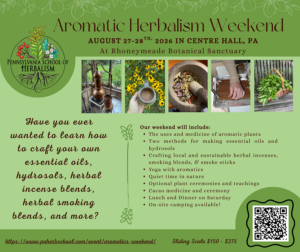
Aromatic Herbalism: Herbal Smokes, Essential oils, Hydrosols, Herbal Incenses + Plant Spirit Event through the Pennsylvania School of Herbalism August 28-30th For those of you on the US East coast, anywhere near Pennsylvania, I’m really excited to share an event we’ve been putting together with the Pennsylvania School of Herbalism. The weekend will focus in two directions: plant ceremonies and aromatic herbalism. On Friday evening, I’ll be offering a workshop on plant spirit communication and a plant spirit initiation. On Saturday, we have a full day planned to learn all about aromatics and aromatic plant preparation using local, wildcrafted, and garden-grown herbs. This includes learning how to craft essential oils and hydrosols using two methods (alembic and kitchen stove), crafting herbal wildcrafted incenses, crafting herbal smokes, and creating herbal smoke sticks. We’ll learn about the power of aromatics and herbal smokes as part of physical and mental health. The event will take place at Rhoneymeade, which is a botanical sanctuary near State College. Camping is available at Rhoneymeade or you can stay at any number of hotels and Air B&Bs nearby. Please check out the full schedule, and a sliding scale is available ($150-$275) to make it affordable for all. Hope to see you there!


I love hearing your perspectives, Dana. I think if I lived alone I, too, would retreat more regularly. In our household we’ve often spoke about ancient practices, living by candlelight at night, making homemade bread, shutting off devices before sleep, and such. But no one around me stays consistent with this lifestyle, and I’ll find myself isolating once again to my office where I can turn off lights and listen to the night. Other times I catch myself watching animal videos too long for creature comfort. LOL! I guess we all ‘gnow’ what we need to attend to within, but the ongoing practice of being human involves mastering consistency, self-forgiveness, and a heartfelt sense of humor for our shortcomings.
Yes, it is very tricky when you live with lots of people. I know people have had success with creating these practices once a week, or on a full moon, or some other intentional way. I was blessed that I had the house to myself for the first half of my retreat, which really allowed me to dive more deeply than I otherwise would. Even the cats were able to realign!
thanks for the slowing down blog–i needed that. happy imbolc!
Yeah! Everything gets faster and faster….we really have to fight to slow down. And it is so worth it!
Such beautiful practices! Thank you for sharing!
You are most welcome! 🙂
Wow, this is a great read, very enlightening. My Celtic hubby and I try to reset when camping outdoors a few long weekends annually.
That’s a great way to shift into ancestral time–I feel like probably the most common among nature spirituality practitioners 🙂