 Dana O'Driscoll
 Last weekend I had an opportunity to offer the Keynote at the Plant Cunning Conference in Central New York. This post is an adaptation from my keynote. The Plant Cunning Gathering was an amazing experience, and I highly recommend this conference to anyone who is interested in herbalism, magic, and permaculture! Thank you to AC and Issac for inviting me to share. This talk, titled “The Animist Herbalist,” synthesizes much of my philosophy about how herbalism can be a gateway to deeper spirit-filled, reciprocal connection. I hope you enjoy! At some point, I will also have access to the recording and will share that when I do. I will also take a moment (as I did a the beginning of my keynote) to acknowledge Jim McDonald, Lillian Wolf, Nate Summers, and Jon Young, whose teachings and writing have helped shape what I share here. Thank you.
An Opening Story
Back in 2023, I had a chance to go on a once-in-a-lifetime writing retreat with my friend, Sue Morris of Sue’s Salves. Sue was working to finish her astrological aromatherapy book, and I was also working to finish Ecospirituality in the 21st Century. I was so excited when she invited me to St. Vincent and the Grenadines to spend some time there while she was housesitting. A few days into our time there, one of the dogs who lived on the land developed an eye infection. While this is something I commonly treat in both humans and animals in Pennsylvania, I had very little knowledge of the plants of St. Vincent. We had hoped to take the dog to a vet, but the vet wasn’t available. So, I went out on the land and asked, “Mother earth, an animal of this land is in need. Can you please show me the medicine?” And the earth did just that–a small tug on my solar plexus led me into the wilder part of the land, and there I came across a massive patch of Wild Dagga (Leonotis leonurus). I sat with the Wild Dagga for a time, and made her an offering. I thought about what I already knew about her. I had primarily grown her for her flower, and we used the flower or leaf as tea or a smoke blend for anxiety. Dagga encouraged me to gather some leaves, and told me that she would work great for healing the dog’s eye. I offered my thanks, and then I took the leaves back to the house. When I got to the house, I pulled out my laptop and spent time reading about her other medicinal virtues–and sure enough, she was what we needed. She was antimicrobial, anti-inflammatory, analgesic, slightly astringent, and slightly demulcent–just perfect for an eye wash. I made up the eye wash and then tried it on my own eye, waiting about 6 hours to make sure there weren’t any ill effects. It worked great, so we began administering it to the dog, who was able to recover.
This opening story helps set the stage for how I discuss animism and what it is in herbal medicine and how people who want to practice any plant-based practice- gardening, herbal medicine, foraging, permaculture, and the like- can all benefit from understanding it.
Humanity is 200,000 years old, and we evolved with plants!
Humanity is about 200,000 years old. For much of that time, we lived on the land in immediate connection and in deep reciprocal relationship with nature. It is in this pre-history, this time before recorded time, where herbalism was born. Herbalism is one of our oldest ancestral traditions. We can see this through the remains from Ötzi the Iceman, the oldest human ever found. Otzi lived around 3300 BCE and had birch polypore (Fomitopsis betulina) and Fomes fomentarius (hoof fungus), along with bracken fern and sphagnum moss in his stomach. Princess Ukok, the Siberian Ice Maiden from 2400 BCE, was found buried in modern-day Siberia and was buried with cannabis and coriander. These ancient people show us that people, plants, and mushrooms have interwoven histories and evolution.
Modern indigenous cultures share this immediate connection to the land- the Aboriginal Australians are a 60,000-year-old culture (read more about them in Tyson Yunkaporta’s Sand Talk). The San People or Bushmen are a present hunter-gatherer culture in southern Africa, and by some records, they have lived sustainably on the land for at least 100,000 years. We have many indigenous cultures all over North America, many of whom have been here 20,000 to 30,000 years.
All of these indigenous cultures had a direct and ongoing interdependence with nature. And, as we can see from both modern evidence and archeological evidence, nearly all of them connected not only to the physical nature but the spirit of nature. Animism – the practice of recognizing the inherent personhood, sovereignty, and spirit of all things—is a foundational system of relationship across indigenous cultures worldwide. This practice is tied to kinship, reciprocity, relationship, and respect. And, most importantly, this relationship and the underlying philosophies of it, created deeply regenerative, balanced interaction between humans and their ecosystem, allowing cultures that are literally tens of thousands of years old.
Sounds great. What happened?
Of course, the dominant system that we find ourselves in today is not a sustainable or balanced one, but rather one that has taken the opposite approach through colonialism. Colonization directly suppressed and sought to destroy indigenous belief systems, ways of life, and interactions with the land. Colonialism replaced a relational worldview that held kinship with nature with a capitalist worldview of extraction. In this worldview, humans are separate from nature. In this worldview, humans and human needs are treated as the only thing that matters, and the world around us is treated as a resource to extract. This means that things like ownership replaced kinship, where colonial systems treated land as property that could be bought, sold, owned, and extracted for profit. This extraction replaced reciprocal systems of interaction that allowed people to stay in balance wiht what they took from the living earth. This worldview also promotes the idea that things should only exist if they have direct utility to humans. And all of this led to efficiency and growth at all costs as the new cultural religion.
We now live in a system with underlying values that focus on what has economic value as the only thing that matters. Even though people are starting to reject these values–strongly–they still form the dominant paradigm. They still form the basic value systems that many people hold onto, even subconsciously. And we see these colonialist and capitalist value systems present in many forms of herbal medicine. We can see this through a view of plants used primarily and only as a tool to use for healing, or plants being part of products to purchase. And this is why we have growing lists of plants on the ICUN Red List and Species at Risk lists from the United Plant Savers.
Indigenous Australian author Tyson Yunkaporta writes in Sand talk that this kind of thinking system is rooted is narcissism, the “I am better than you” mentality. He argues that this is the foundational root of colonization and that narcissism is the most dangerous thing for humans and human culture. He argues that part of why Aboriginal Australian culture lasted 60,000 years is that they had–and still have–cultural protections against it. “I am better than you” allows extraction, ownership, profit, and greed. It allows us humans to think we are somehow more deserving and that our needs matter more than other life on this planet.
And, we are now at a time where it is clear that these capitalist and colonialist ideals are destructive to all life here and are threatening all of us with extinction. The need to directly confront these ideals and replace them with something better is critical. One of the big reasons that I practice and teach herbalism and reciprocal foraging practices is to re-establish those kinship relationships, de-colonize and re-indigenize us to place, and help us replace these destructive worldviews with ones that are sustaining and relational. I have found that herbalism is an amazing angle into this kind of work, particularly in more conservative communities, like where I live. I see teaching animist worldviews as one of the solutions to the predicament of our age.
The Animist Herbalist
I will note first that while I am talking about animsim as it applies to the practice of herbalism, you can also apply animism to any other nature-based practice, and while my examples are specific to herbalism, you can find broad applicability of these ideas in many nature-oriented practices. For example, animism also has space in gardening, permaculture, earth skills, natural building, and so many other places.
What is an animist herbalism practice? An animist herbalist practice cultivates a relational, embedded, and spirit-filled framework with plants, mushrooms, and trees. Core principles of animistic herbalism are recognizing the personhood of all beings, cultivating relationships with healing medicines and ecosystems, and practicing reciprocity and respect for plants-as-people. Let’s now break each of these down and see how we can connect them to specific practices.
Five principles that underlie an animistic philosophy:
- Personhood extends beyond humans. Animals, plants, mushrooms, rivers, mountains, weather systems, and other beings possess awareness, personhood, agency, and spirit. The world is populated by other people, not objects. As herbalists, we can learn how to interact with the plants, trees, and mushrooms as persons—learning from them as teachers and guides. If we assume this to be true, then we can use all the things we know and understand about human relationships to nature to rebuild our own relationships with nature.
- Relationship is central. Each of us are embedded within a web of relationships to our biosphere, watershed, ecosystem, and world of non-human persons that we live with. It is up to us to honor and acknowledge those relationships, and to make them a central part of our being. When we build knowledge about these relationships, we recognize that some of this knowledge comes from ongoing interactions with these beings, rather than just observation at a distance or reading about them online. As herbalists, we can cultivate these relationships as a central part of our practice. Those relationships can come to define us, our work, and our medicine.

One example of an ally you might meet! - Reciprocity should govern relationships with plants. In this view, taking from the land creates an obligation to the land. Any benefits we gain from the land (healing medicines) should be balanced through gratitude, stewardship, care, and also by taking only what we need. These practices may include offerings, gratitude, sharing resources, conservation, actively creating herbal sanctuaries for life, taking only what we need, using what we take, teaching others, and honoring the medicine. And we can explore reciprocity not only with a specific plant, but also with the plant species, and also with the broader ecosystem to which they belong.
- Respect and recognition are basic practices for interaction with persons. Just as you would interact with any human being, we practice animism when we recognize that we need to treat plants, mushrooms, trees, and any other people respectfully. This includes: asking permission, avoiding unnecessary harm or taking too much, respectful language use, and offering gratitude. This includes seeing them as people, speaking to them as you would speak to other people, and giving them the same courtesy you would to human people.
- Humans are part of a larger community of beings; equal with all others. This view shifts us from an anthropocentric view (humans and their needs at the center) to an egocentric or biocentric view (humans as part of a web of life). We all were born on this planet, and we all have a right to live here in peace.
Ultimately, it is our actions and practices that shape the world. And that’s why I say that I see animism is less of a belief than it is a system of relationships that we cultivate and enact with the world. Because it is relatively easy in this world to hold various beliefs. In the case of things that go against the dominant capitalist and colonialist paradigm, it is very, very difficult to enact these beliefs meaningfully in the world. So to me, actions, and not beliefs, form the central point of this practice.
Core Animist Practices
If we are going to enact the above beliefs in the world, how might we do so? This first group of practices is what I consider to be foundational practices—and they are useful for everyone, even if you don’t believe in the “spirit” piece of animism. I call them foundational practices because everything else we might do that is more advanced is still rooted in these. I work to teach these through all my classes with the Pennsylvania School of Herbalism, and it always surprises me how even people with very different spiritual frameworks than me really yearn for learning a different interaction with the land. They want to be reciprocal, have gratitude, and be a good steward. This means that even if you aren’t overtly teaching animism, you are teaching them something they can use, and that shifts consciousness- and will help us shift the world.
Gratitude practice
Gratitude is a great place to begin with moving into a more relational framework with the world—and it’s a place that is accessible to all people, regardless of their belief system. This can be as simple as saying “thank you, “ which acknowledges the personhood of the other being and what is being taken. Jonathan Tudge at the University of North Carolina recognizes that gratitude has different cultural implications, and different cultures enact it differently. Two major categories he notes are verbal gratitude – saying thank you in some way and concrete gratitude – reciprocating with something. I personally like to combine both of these kinds of gratitude. But for now, here are some simple practices:
- Herbal offering blend: Before harvest or just to say thanks, leave a pinch of herbs. More on offering blends and shrines here.
- Music, Singing, creative practices: Learn to play a flute or drum, bring your voice to the plants.
- Gifts of the body: Hair, liquid gold (urine)
- Energy Exchange: Raising energy and directing it through ceremony or other practices, like Reiki.
- Purchased plants or medicine: Take a moment to offer your thanks to the plants, the land where they grew, and those who harvested them.
These kinds of practices were traditionally done by all peoples and cultures. They nourish the land and remind us of reciprocity. To me, they are the very best place to start to develop animist-based awareness and understandings of the world. We can always work to bring more deep gratitude into our lives.
Respect and Reciprocity
As we move through gratitude and recognize plants-as-people, we can deepen our interactions with these healing beings through respect and reciprocity.
Respect is acknowledging the plants as sovereign beings who are deserving of our respect as the ancient teachers and healers that they are to our species. This means we hold them in high regard, we listen to what they say, and we honor their medicine. Here are three such practices for respectful interactions:
- Harvesting with minimal damage and care; recognizing you are harvesting from a living being, and that harvest has consequences to that being
- Harvesting to ensure no lasting harm (e.g. harvesting rhizomes between plants, and being especially careful with root harvests or harvesting sensitive populations)
- Treating plant matter respectfully. This includes using what we take to the best of our ability and, after we are done, returning the plant matter to the earth after each use.
Reciprocity is recognizing that when we take something from nature, we need to equally give back. Above, I said that harvesting from the land creates an obligation to that land, and that is true of all things–all things we have in our lives come from nature, and so we all are obligated to tending and reciprocating with nature. But herbalism or wild harvesting practice makes this more concrete in many people’s minds. We can give back in many different ways: conservation work, cultivating refugia, bringing the land into balance by removing opportunistic species out of balance and making medicine from them, activism, spreading native seeds and plants, and of course, ceremony.
Reciprocity is really critical because most people are socialized to only know how to be consumers and only be in a consumptive relationship with the world—embracing respect, and reciprocity teaches something different. And that deeply shifts consciousness and helps people realize that there are many ways of interacting with nature beyond consumption.
As an example of one such practice, the Pennsylvania School of Herbalism has adopted an area in one of our local county parks, and we regularly remove invasive species (barberry and knotweed) for medicine. I also offer free walks to help people connect with nature in that same park. What I love about the opportunistic plant species pull and medicine-making days is that these are a way of showing people how the energy of harvesting can be turned into a good thing that benefits the land and that they can be a force of good to bring balance and healing.
Personhood and Permission
Gratitude, respect, and reciprocity all help us to deeply interrogate and deprogram our own minds to move away from anthropocentrism (human-centric thinking). With this practice, we move across the line into an animistic-herbal practice, where we seek to build deep kinship relationships. For this, I see two core concepts:
- Personhood: We can treat plants with the same respect we would treat a human elder (engaging in gifts, respect, reciprocity). This includes how we grow them, harvest them, tend them, and interact.
- Language: shapes our realities, and I think one of the ways we can shift into more person-oriented thinking is by attending to our language. For example, what changes when we call a healing plant “it” vs. “thou/they/she/he” or “grandmother/grandfather”? Consider also how we share information on the plants themselves and talk about them. Learn from them and interact as people. Think about what this means to you. For more on an animist approach to the English language, you can visit this link.
- Permission: Ask permission for what you do on the land. Listen to “no” and respect “yes” as the gift that is given. I’ll get into permission a bit later in this.
Example of these principles in action
If you are out in the wilds and interested in foraging plants, mushrooms, or trees for herbal medicine, bushcraft, food, or other human uses, you can use this simple practice, which I have adapted from teachings of Lillian Wolf. First, ask permission of the plant to sit near them. If you get a “yes”, then sit, giving the plant a compliment, the same as you would do any other person. Then, use all of your senses to observe. Make an offering. Then say, “Grandmother, may I harvest some of your leaves? If so, how much?” Sit with that in your intuition. Do not harvest unless you are given explicit permission.
In the garden, the practices are the same. Come into your garden with love and joy. Just because you planted these plants, they are still sovereign beings, and we need to offer gratitude, respect, and engage in reciprocal and permission-based interactions with them. I suggest you engage in regular ceremony for your garden, and establish your relationship with the plants growing. And when you want to harvest, use the same instructions I just shared for wild plants: sit with them, give them compliments, be with them, and ask to harvest.

Opening Intuitive Energy Centers for Plant Spirit Communication and Materia Medica
How do I know if a plant has said yes or no? How can I be sure that permission has been given? To this, we turn to Plant Spirit Communication. Plant spirit communication is a human skill that we can all engage in. Just as our indigenous ancestors interacted in a living, enchanted world of spirits, so can we. Plant spirit communication is when we connect to the spirit of the plant—for in an animist perspective, humans are not unique; literally everything has spirit. All things—which include not only all plants, trees, and mushrooms, but all ecosystems, all of your tools (anything that comes from the land), even your house or car. This requires some work on our part because we are socialized to shut this part of us down as we age, and when many of us start learning this as adults, we have no human teachers and no clear way forward. To begin to get into this, I want to, in herbalist fashion, talk about how we can use certain plants as gateways to help open up our energy centers and understand those energy centers.
Many different esoteric and indigenous traditions recognize energy centers in our bodies that connect us to the metaphysical world around us as well as our higher self and the divine. These energy centers are like communication channels to the spirit of all things. Capitalism and colonialism have split our minds from our bodies and also disconnected us from our spirits. In modern culture, there is only an acknowledgement of the physical plane, and only for our five senses. Two of the energy centers that I think are particularly useful for plant spirit communication work are the Third Eye and the Solar Plexus.
The Third Eye and the Pineal
The Pineal is a tiny endocrine gland near the center of our brain – it sits right between the left and right lobes of our brain.
- Medically, the gland synchronizes our circadian rhythms, our seasonal biological rhythms, produces melatonin, and governs our sleep cycles. Pineal is associated with cultivating quietude, dreaming, meditation, and restorative sleep. Pineal is called Pine-eal” because it is literally a pine-cone shaped gland; the pine cone itself has deep spiritual significance
- Esoterically, the pineal is known as our third eye and is associated with inner vision, clairvoyance, intuition, spiritual perception, and direct spiritual knowledge or “individual gnosis”
The way that I see it is that the pineal is one of the places where we bridge between matter and spirit and consciousness/soul and the greater mystery and divine around us. This is critical in an age where our attention is constantly trying to be stolen and diverted to various screens.
Herbal ally for the Pineal and Third Eye: Pine. There are no traditional classic herbs associated with the Pineal gland itself that I can find—but because of the name and shape and the doctrine of signatures, Pine is the obvious choice. Medicinally, pine needles are aromatic, warming, drying, stimulating, and dispersing. Pine restores warmth where there is cold, movement where there is stagnation, and resilience where there has been prolonged exposure to hardship. If we think about how our own energy centers are shut down by our culture, we can see the magic and wonder of the pine as an “opener” of this very spiritual center, allowing us to have focus, quiet, and peace, so we can hear the quiet voices of the plants. Pine is able to create movement in our energy center where there was once stagnation, and open us up again to the world of spirit beyond us.
Here is a link to my White Pine handout from the Pennsylvania School of Herbalism with the medicinal qualities of this wonderful tree.
The Solar Plexus
The second energy center in our body that is really important for plant spirit work is the solar plexus. The Solar Plexus is a very large convergence point of nerves in your body in our abdomen that has nerves radiating out of it, just like the sun. Medically, the solar plexus is an organ of perception and coordination. It coordinates the entire GI system—which is tied not only to our own vital energy and removal of toxins but also to our emotions, cognition, and perception. Strong emotions are often produced here – a gut feeling, butterflies in your stomach, getting a gut punch.
The solar plexus is also the seat of our body-based intuition. Intuition is often framed in Western Society as something that is mystical, magical, or otherwise extrasensory. However, multiple global traditions recognize that the seat of our intuition is in our bodies, specifically, in our solar plexus. Indigenous and ancestral traditions globally recognize this to be true. For example, in Ropes to God: Experiencing the Bushman Spiritual Universe, Keeny describes the Namibian San Bushmen’s conception of connections between all beings as being a “rope” or “cord” between the solar plexus of a person and another animal. Jon Young describes this as “spirit tracking” or “intuitive tracking” and teaches a range of skills to help us open up our intuitive centers. As we work with plant spirits, we create cords between us, and those cords strengthen and grow over time.
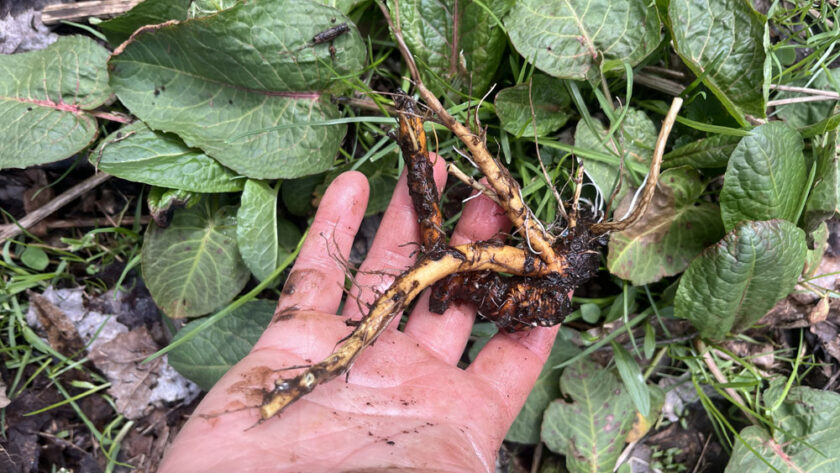
Herbal Ally for Solar Plexus: Wood Betony is a solar plexus trophorestorative herb that works on all levels: in our gut, in our nervous system, in our minds, on our psychological brain patterns, and on our spirits. Matthew Wood talks about the Wood Betony Personality in his Book of Herbal Wisdom: he notes Wood Betony is perfect for people who feel “ungrounded” and feel spacey or disconnected from their everyday reality–and what he is describing is a disconnection between mind, body, and spirit. Wood Betony will help focus and strengthen us, filling us up with our own willpower and sense of self. And as an esoteric herb, she has thousands of years as a protective herb that enhances our perception, clarity, and focus by quieting our nerves, nourishing our body, and allowing us to focus.
Here is a link to The Pennsylvania School of Herbalism’s Wood Betony Handout with the medicinal qualities of this wonderful plant.
A Threshold Herb: Mugwort
While we have two great herbs for plant spirit communication and opening up our energy centers, as a druid, I do everything in threes, which helps create more stability and balance–and a nice formula for an annointing oil or salve (see below). And thus, to formulate something to support plant spirit communication, the third herb I like to include in a blend like this is a threshold herb. A protective herb to help us connect between our third eye and solar plexus, to bridge between our conscious and subconscious awareness, and to help raise our awareness.
Mugwort chose to work with us in this way, but you could use any other threshold herbs like Elder, Hawthorn, or Angelica.
- Medicinally, Mugwort is a bitter and pungent herb that has a wide range of effects on the body, including functioning as an alterative, removing parasites, providing digestive support, having a slight warming and diaphoretic action, as a diuretic, and more. But one of her most famous uses is as an Oneirogen– an herb that helps us get into a deeper REM sleep state and dream deeply.
- Esoterically: Mugwort is also a potent spiritual ally, offering us deep protection and helping us bridge between the world of spirit and the intuitive centers in our body. Mugwort has also traditionally been used for boundary crossing, travel, divination, and protection. She is a perfect complement in herbal allies in opening you up to the work of animism, herbalism, and connecting with plants intuitively. In this role, I see her as a bridge between the world of spirit and our body-based knowing.
See the PA Herb School’s Mugwort Materia Medica.
Opening to Spirits Salve Recipe
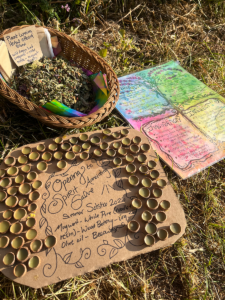
As part of the keynote talk, I created “Opening to Spirits” Salve, which I shared in small acorn caps from the northern white oak. This was the recipe I used to share with others–and feel free to use it or adapt it for your own purposes.
- ½ cup of fresh or ¼ cup dried pine needles
- 1 tablespoon pine resin*
- ½ cup of fresh or ½ cup of dried wood betony
- ½ cup fresh or ¼ cup dried Mugwort
- 1 ½ cups olive oil
- 1 tablespoon oak leaves or acorns
- 2-3 tablespoons of beeswax
In a double boiler, add herbs and olive oil. If you are using fresh herbs, macerate the herbs in the oil over low heat with the lid off to ensure that the water can evaporate and escape. For dried herbs, you can add a lid. Please note that you should add the pine resin after all other ingredients are in. For best results, powder the resin in your mortar and pestle. Resin might stick to the bottom of your pan or pestle—you can remove it with 95% alcohol (including rubbing alcohol). Once you have macerated your herbs for at least 24 hours, you can strain and add beeswax.
You can also use additional techniques to build more sacredness into this process: create in an open ceremonial space, create by the light of the full moon, create at a solstice or equinox or on a day of astrological significance.
Ceremony for Activating our Energy Centers and Being Open to Plant Spirit Wisdom
This ceremony uses the Opening to Spirits oil to help open our energy centers for plant spirit connection and communication. The italic text is instructions while the bold text is what you can say. Feel free to use this and adapt it as you see fit! I offered this ceremony for everyone to anoint themselves and be open to plant spirits as part of the keynote.
Begin by taking three deep breaths: 1) with the sky above you; 2) with the earth beneath you, and 3) with the waters around you. Recognize that this is sacred time, this is sacred space.
Anoint your third eye.
I awaken my third eye, that my mind may still to receive messages from my plant, tree, and mushroom teachers and connect with the world of spirit.
May the Pine teach me stillness and gratitude.
Anoint your solar plexus.
I anoint my solar plexus, that our body may remember that I am already in sacred relationship with all beings and in a world that is alive and responsive.
May Wood Betony teach me to trust my intuition and body-based knowing.
Anoint your heart.
I awaken my heart to ensure I am open to perceive and to respectfully integrate the lessons from our plant, mushroom, and tree teachers.
May Mugwort teach me care, respect, and reciprocity.
Anoint your hands.
I anoint my hands and our feet, reminding me to walk in balance and be wise in what we learn and teach.
May the Oak strengthen and balance us.
I now enter into kinship. May the plant spirits guide my path to becoming a good ancestor.
Plant Spirit Communication: Practices
Now that we understand that plant spirit communication is body-based—we can start talking about specific practices. I will note that you can practice these for a lifetime, and there are many journeys to take with them, and so today, I will share the core practices that I use regularly as well as links to more information for deeper practices.
Nature needs space to communicate.
The most important thing to remember about plant spirit communication is that nature respects you too much to speak over you. If you don’t create space and quiet for nature and for the quiet voices of the plants, you’ll never hear them. To use our human relationship analogy, here you might think about someone who is always talking; there is never space for conversation. That friend who talks constantly and does not shut up. It is the same in our own minds. If you are always talking or have other human voices running through your mind constantly, there is no space for the quiet voices of nature.
Opening and quieting the mind.
And so, as you get deeper into this work, you will want to develop meditative practices that help open and quiet the mind while also eliminating technology and distraction. Ditch the screen and embrace the green. Here are a few meditative practices that are good for this kind of work:
- Plant meditation. Go ask permission to sit quietly with a plant. Open up yourself. Silently observe and interact. Tune in to your solar plexus and to your third eye. See what comes.
- Sense meditation: Sit with the plant and then tune into each of your senses, ending with your solar plexus and third eye. See what comes.
- Movement meditation: Walk quietly through the land and open your awareness. Or, engage in some form of repetitive movement like weeding your garden or processing herbs where you can quiet your mind and stay open. See what comes.
- More on meditation from a druid perspective is here: Druid’s Meditation Primer.

Plant Spirit Communication
Once you have some quietude in your mind, you can then seek messages and communication from the plants–they are so ready and willing to share! Now we can return to my opening story for some idea of how to do this. Go out into nature, your garden, wherever you are, and take a moment to tune into your body. Activate your solar plexus—focus on it, do energy work, rub salve on it, etc. Then, we are going to ask what Jon Young calls the “sacred question” — this can either be an open question or one of need. A good question to get started is, “Mother nature, what wisdom do you have for me today?” You will feel a gentle tug on your solar plexus—follow that tug to find a plant who might want to build a relationship with.
Once you find a plant, start with permission – ask to sit, ask to interact. Give an offering and offer your gratitude.
From there, tune into your senses – pay attention to the plant. Are there things that draw your attention? What do you notice? Remember that the doctrine of signatures—the way the plant grows—has much wisdom to teach us.
Keep your mind quiet as you focus on working with the plant.
Pay attention for any other messages: people receive all sorts of different kinds of messages in spirit communication. In fact, as that post I linked in the last sentence shares, we all have a default mode or native language that we often get for sharing messages, but we can learn others. For example, you might be really good at sensing energy but not great at hearing the voices of the plants. We are all different in this, and that diversity is beautiful. Thus, you might find yourself:
-
- Hearing the quiet voice of the plant
- Having deep knowing
- Feeling emotions or release
- Seeing visuals or experiencing visuals in your inner eye
- Feeling a sense of energy
- Having a sense of peace
- Receiving a gift of a painting, or a song, teachings, or a formula
- All of these are different communication methods, and all are part of your own personal gnosis—your own growing knowledge—in building relationships with the plants. You might find yourself leaning into one or more of these.
Plant spirit communication and its associated practices take time to practice and do well. It may be months of regular practice before you can easily communicate with plants—this is a skill you have to build. Give yourself time and be patient. There are a lot of layers beyond this simple plant communication practice; however, this is the foundation for many things. I have included links to more advanced practices below.
Using Plant Knowledge and Your Personal Gnosis
The last thing I want to share today is about personal gnosis. “Gnosis” is a Greek word for “knowledge” or “awareness,” and it is often related to our own mystical, divine, deeper, or spiritual intuitive understandings of the world. What we get through our intuition and plant spirit communication is extremely valuable knowledge, but it is also necessary to understand the place of this knowledge in your herbalism practice.
First, don’t ever assume that your personal gnosis is meant for others. Don’t assume that what you have learned is, or should be, part of the larger body of wisdom that applies to others. You can check—a lot of times a plant may share a legitimate use hat you did not know (as in the story of Wild Dagga). But at other times, personal gnosis is personal, and if you are going to share it, you should share it in the context of how you got it.
Because of this, I find that it is helpful to synthesize all that we learn from many sources in order to understand the plants and their teachings. This means you can combine your personal gnosis with centuries of herbal wisdom, with study with other humans about the plants, with direct observation, with using the plant and seeing how she works, and current contemporary human knowledge. I keep a book for this where I write down core knowledge the plants share with me that is more esoteric in nature. Some of it is private, some of it is worked into various projects (like the Plant Spirit Oracle), and still other knowledge may be something that aligns with broader human knowledge, and then can be integrated into my larger herbal practice.
It is really important to realize that some of what the plants tell you is just for you.
Also, if you aren’t careful and you share too quickly, you can talk the magic out of what you share. A good teaching that was shared with me was to wait at least seven days before you share.
Finally, remember that the plant may have its own relationship with you. And that relationship may be the medicine that you–and only you–need.
For more details on this from a pagan perspective, you can see: UPG and Me: On Gnosis, Personal Gnosis, and Unverifiable Personal Gnosis in NeoPagan Practices.
Matthew Wood and Jim McDonald both teach three I’s associated with herbal wisdom which are particularly useful to balance the intuition with the intellect. I have combined their 3I’s which are slightly different, into four, and I find these are helpful for considering the role of personal gnosis with plant spirit communication. How am I bringing together my intellect, imagination, intuition, and instinct? How am I synthesizing this information into something I can use and grow from?

Conclusion
That’s it for what I shared at Plant Cunning! I hope you enjoyed it, and that this information is helpful to you. I look forward to hearing from you about how these practices work and other practices you might use to create a deeper animist herbal practice!
Resources and Information for Advanced Plant Spirit Communication Practices:
- Plant Spirit Communication Series of Articles: Plant Spirit Communication Parts 1-4: Your Native Language, Many Ways Plants Communicate, Spirit Journeying with Plants and Medicine for the Body and Soul. Learning to communicate with plant spirits is a huge part of magical herbalism practice. This is my original series on Plant Spirit Communication; longer versions of this also appear in my book for the Plant Spirit Oracle and also my articles from 2023-2025 from Plant Healer Quarterly.
- Finding the Face of the Tree: Sometimes the trees themselves share lessons with us about how to work with them, to talk with them, heal with them. Finding the face of a tree is a fun practice that can help get you started on the path to deeper tree work!
- Plant Spirit Journeying: Spirit journeying (aka. astral travel, shamanic journeying, pathworking) is a deeper and more advanced practice than what I share here. I have a series of posts that outline the basic practices of spirit journeying in a safe and effective way: preliminary and preparatory work, connecting with a spirit guide, establishing your inner grove as a safe space to travel from, and engaging in deeper work. If you are going to get into this work, I also suggest reading: Metaphysical Street Smarts and Daily Protective Practices.
Practicing Ethics and Reverence for Animism.
- An Exploration of Gratitude Practices and Plant Reverence in Herbal Practices: One of my writings for Plant Healer Quarterly, where I provide a thorough introduction to developing gratitude and plant reverence practices, focused on the herbalist as a primary audience. To me, this is a foundational practice of herbalism.
PS: I know my absence on the blog was longer than I intended or shared at the beginning of May. I think that all of us are dealing with the collapse in our own way. To be honest, I have found it hard to survive, fight three fossil fuel nightmare projects in my community, keep up with life and my obligations, and also write. Thus, I will be moving to a monthly post schedule until the remainder of the year. But I’m back now, and look forward to another post in a few weeks! 🙂


It is so good to hear from you! I’m glad you’re back. Thank you for this well written and wonderful resource guide! I’ve been struggling with balance in my life and dealing with grief as we watch the collapse of our country and planet. It’s overwhelming. But I’m very lucky to have a wonderful pagan animist community that I get to regularly celebrate the wheel of the year and contribute to rituals. Next is a land healing group with my drumming and singing friends. We need this and the land around us that has been over logged does too.
Hi Rhonda, thanks for your kind words. I am back in a more limited capacity due to my own grief about the world. I think we are all struggling and honestly, I have lots to say but I’m having difficulty bringing it forward. But I’ll do my best to keep putting good things out there! I’m so glad to hear about your local community–that is a balm in these weary times.
Thank you for this post and welcome back!
I particularly notice Wood Betony appearing so prominently. I feel she wants me to share the following.
Earlier in the year I ‘asked’ who could help a severely ailing friend with plant spirit medicine, and ‘heard’ Wood Betony. She is native to where I am but I had never seen her, and didn’t know anything about her. I did some research and then worked with Wood Betony and my friend as a plant spirit working, and also committed to grow Wood Betony- we agreed I will start a place for healing herbs in my local Community Garden. This whole experience has been very significant for me as I am only taking my first steps in this kind of work.
I have started with three Wood Betony plants in my own garden, so I can care for her and propagate from there once the plants are established. We are in drought where I live; most of my garden is wild/native plants and I notice that they are coping relatively well and I’m hopeful that once she’s established Wood Betony will become part of this balanced system. Right now, though, I notice that she is not thriving and nor am I. I learnt from your handout how much I, also, need her help.
I am going to focus more clearly on this wonderful herb.
Wood Betony is such a beloved herb! I’m so glad you have been able to connect with her and her wisdom. She is definitely a balm for this age. Here I have a very established set of plants and she has done well where I live in the droughts–I have her planted in some below-ground hugelklutur beds (which are good at holding moisture) and she has endured during the droughts. I will be able to split her hopefully this spring after many years! 🙂 I hope she brings you connect, wisdom, creativity, and joy!
Extremely generous offering!! Thank you so much!!
You are most welcome! Thank you so much for reading!