
 Dana O'Driscoll
One of my favorite times of the year is spring–when the land is awakening, and the green is returning! Beltane is here! Here in the Allegheny mountains, one of our folk herbal traditions is to “thicken” the blood in the fall with nourishing root teas like those made of Burdock (Articum lappa) and Sassafras root (Sassafras albidum) and then in the springtime, “thin” the blood with spring greens like dandelion leaf (Taraxacum officinale), garilc mustard (Alliaria petiolata) and chickweed (Stellaria media). This was, in part, because diets radically changed in the winter months. As people got closer to the end of the year, the holiday feasts were in part to use up many of the stored vegetables and fruits (especially things like apples, pears, onions) before they went bad. In the coldest season of the year–January, February, and March – people often would live on preserved foods and high-fat meats until the spring greens emerged. This old folk wisdom was spot on–in more modern terms, the spring greens were not only highly nutritious and nourishing (with high levels of Vitamins A, C, E, K, Magnesium, Calcium, Iron, and more) but they also had tonic effects on the body’s elimination systems–the kidneys, liver, gall bladder, and entire digestive system. So when we think about “spring cleaning,” we can use these amazing greens to clean out our systems and get us ready for the rest of the year.
In the rest of this post, I’ll share some of my favorite spring greens, how to prepare and harvest them, and some things you can do with them. You can build these greens into your diet in so many ways: smoothies, pestos, hummus, stir fry, soup, salads, and more. You can also readily preserve them for future use–and I’ll walk you through all of this step by step!
Preliminaries
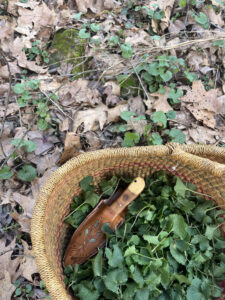
Ethics and reciprocation. I want to start by centering our discussion of foraging on ethics, regeneration, and stewardship. There are too many social media groups where people post photos of their pillaging of the land. Capitalist and colonialist attitudes towards foraging and harvest have created a situation where many of our most important foods and medicines–medicines and foods that other life depends on–are quickly being foraged out of existence. Please see my ethical foraging guidelines for more information. For each of these plants, I will also note information on how much you can harvest. Some of these plants, especially Garlic Mustard, can be harvested in great quantity as harvesting this plant is good for the ecosystem as it is an opportunistic (invasive) species that displaces others in the ecosystem. A lot of these spring greens also show up in spaces like your garden beds or paths, and you end up pulling them out–but if you are already going to pull them out, why not make them into food? The important thing here is that there are many options–you want to harvest those that are either opportunistic (invasive) or naturalized and abundant.
Safety: The second thing is that you want to practice very good foraging safety. Some spring greens are in a classification of plants that uptake a lot of nutrients in the soil–but they can also uptake contamination or heavy metals in the soil. You should not forage around old buildings that had lead paint, within 50 feet of a roadway (due to leaded gasoline being used in cars for many years), and avoid any areas that are sprayed with pesticides, herbicides, or other chemicals. Unfortunately, that includes many lawns where you can find these plants. You can see more details at my two posts on foraging timing and tools (Part I) and foraging safety (Part II) and guidelines.
Learning and Growth: I have taught about Spring Green foraging for many years, and recently taught three in-person classes on this topic for different groups. There are a few places where people often struggle. The first way that they struggle is simply in having the confidence to identify and forage wild greens. Do not eat plants, mushrooms, or anything else that comes from the wilds without a positive ID. I do not suggest depending on social media for this, nor on AI, or using only an app. You want to learn from people who know the greens and can positively ID them, or from high-quality books written either before 2022 or by reputable authors that you trust not to use AI, such as Samuel Thayer’s works. This is really critical as there are a number of fully AI-generated books that are dangerous on the market right now.

Harvest new green growth. In foraging and herbalism, we always want to harvest with the energy of the plant. What this means is that you want to harvest where the plant is putting the energy–is it in the leaves and growth? Is it in the flowers? The seeds? If you harvest leaves when the plant is putting on flowers or seeds, you will end up with woody and bitter flavors. So harvest greens before the plants go into flower or seed for the most tender, delicious greens.
The bitter truth. About half of the greens I will share below have some bitterness to them. In some cultures, bitter flavors are embraced. Where I live in the US, we have an aversion to Bitter greens and most bitter flavors are completely missing from our cuisine. We also have some of the highest use of GI-reducing pharmaceuticals in the world (PPIs, acid reducers, etc), and those two things are linked. Bitter flavors help stimulate a whole range of digestive activity that can help you digest your food better, reduce or eliminate GI distress, and also help your body extract the most nutrition possible. I have a write-up on Bitters and their medicinal actions at the Pennsylvania School of Herbalism for more info.
A Wheel of Spring Greens
The Spring Green season is quite long, and one of the joys of this practice is that you can learn what order the plants grow in in the ecosystem where you live. Once you have learned to positively ID different abundant plants, I will share what is growing on my land as an example, but you will have to use your own observational skills to identify and learn the timing of your own plants. Generally, the idea is–when you see green plants coming forth in abundance, learn what they are! Chances are, some of them are on my list below.
Spring Superstar: Nettle!

Stinging Nettle (Urtica dioica / Laportea canadensis) –Nettle family – Deep green plant with leaves and fine stinging hairs that cause stinging when touched fresh. Nettle is similar to spinach when cooked with its own unique and delicious flavor. Highly nutritious with high amounts of iron, magnesium, vitamin A, C, E, K, and Silica, among other minerals and vitamins.
Stinging Nettle gets her own entry here because she has a very long harvest window. She can be harvested throughout the spring and summer season–like other plants, she will go into flower in the middle part of the summer, and her leaves will get tougher and more woody.
In the Spring: you can harvest just the four leaves at the tops (I like to harvest with scissors, and a bowl and then the nettle will send new shoots out to grow. Nettles should be harvested with gloves. When the nettles are older, and they start to get tough, you can bend them down to the ground, and then the nettle send up new shoots for tender new growth.
Steam or stir fry for 3-4 minutes to remove the sting. Drying mostly removes the sting, but not entirely.
I will note here that Woodland Nettle (Laportea canadensis) is interchangeable with Stinging Nettle. It used to be that Woodland Nettle was available in many forest stream beds. While I used to harvest Woodland nettle because she grew very abundantly, I no longer do. My region has been threatened with continual summer droughts, and I have watched many areas that once contained great amounts of Woodland Nettle dry out too much, which has caused serious strain to this species. Thus, I have removed Woodland Nettle from my own foraging lists, and I no longer teach this plant during plant walks. You can instead cultivate a patch of Stinging Nettle for yourself in any full sun or part shade area and have abundant food and medicine for three seasons.

Early Season Greens
In my ecosystem, these are some of the first greens to emerge after the long winter. In my ecosystem, I can start harvesting these in mid to late March or early April most years.

- Garlic Mustard (Alliaria petiolata) – Brassica family – A biennial with heart-shaped, scalloped leaves and small white four-petaled flowers that all smell like garlic when crushed. Mildly bitter with a garlicky, mustard-like flavor that becomes sharper as the plant matures. Garlic Mustard is a biennial. You will want to harvest in 1st year to prevent garlic mustard from going to seed and spreading. You will want to harvest before it sends up the stalk–you will know because garlic mustard leaves change from a rounded, scallop-shaped leaf to a more pointed leaf, and this indicates a more bitter and sharper taste. If you get to Garlic Mustard a little late, they will just be more bitter.
- Dandelion (Taraxacum officinale) – Asteracea family – A basal rosette of deeply toothed leaves with hollow stems that produce bright yellow flowers. Bitterness increases with age, earthy and mineral taste. The entire plant is edible and medicinal. I put this in the “early season greens” as once the dandelions go to flower and seed, the greens are very bitter. You will want to harvest them before they send up their flower stalks.
- Hairy Bittercress (Cardamine hirsuta) – Brassica family – A small, low-growing plant with delicate compound leaves and tiny white four-petaled flowers, often found in disturbed soil. Peppery and mildly bitter with a quick, radish-like bite. Harvest these when they are still in their basal rosette form; once they send up flowers and seeds, they get very bitter.
Mid-Season Greens

These are greens that are in their prime in my ecosystem in April.
- Chickweed (Stellaria media) – Carnation family – A low-growing, sprawling plant with small oval leaves and tiny white star-like flowers, often forming dense mats. Mild, slightly sweet, and succulent with a flavor similar to fresh peas
- Shepherd’s Purse (Capsella bursa-pastoris) – Mustard family: A small plant with a basal rosette and distinctive heart-shaped seed pods along the stem. Peppery and slightly bitter, similar to a mild mustard green.
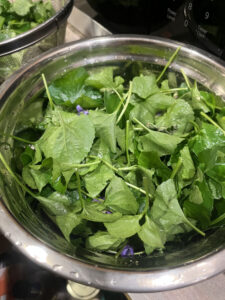
- Violet Leaves and Flowers (Viola spp.) – Violet Family – Heart-shaped leaves growing low to the ground, often near small purple, white, or yellow flowers. Very mild and slightly mucilaginous, with a gentle, fresh green taste. You can also eat the flowers! Violet leaves are best when they are young, but stay surprisingly mild and nice even after the plant is in flower, unlike a lot of other plants I have listed here!
- Canada Goldenrod (Solidago canadensis). You can harvest Goldenrod shoots and leaves early in the season. They have a really unique flavor and slight bitterness (which is medicinal). Often, Goldenrod grows in huge amounts and is often found in a lot of abundance.
Late-Season Greens
As we move into May, yet another set of spring greens emerges. At this point, most of the early greens are in seed and too bitter, but you can turn your attention to any of these to continue the greeny goodness!
- Lamb’s Quarters (Chenopodium album) – An upright plant with soft, gray-green leaves often coated in a powdery white film. Mild, spinach-like flavor, very tasty even when older
- Plantain (Plantago major / Plantago lanceolata) – Plantain Family. A low-growing rosette with broad or lance-shaped leaves featuring prominent parallel veins. Mild “green” flavor
- All heal (Prunella vulgaris) – Mint Family – A low-growing plant with opposite leaves and small purple flower spikes, commonly found in lawns and meadows. Mild and slightly bitter with subtle herbal notes, often used more for its nutritive value than for its strong flavor.
- Tree Leaves: Linden, Maple, Beech. I will not harvest leaves from trees, generally speaking, but I do keep an eye out for fallen branches from spring storms. If you see a beech, linden, or maple tree down in a storm and the leaves are young, these also make amazing salad greens.
Preparation of Greens
Garble, Garble, Garble
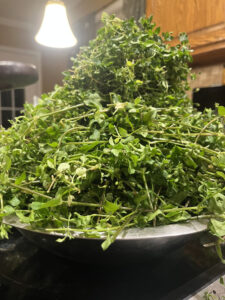
Garbling refers to removing any dirt, debris, and making sure you have only the plants you intended to harvest, safely relocating insects back to nature, and so forth. Good garbling begins with good harvesting–do not harvest plants with roots attached. Cut them carefully to avoid any roots. With opportunistic plants like Garlic Mustard, I harvest the whole plant to remove it from the ecosystem, and then I will cut the green leaves off of the plant and leave the root to dry out on the earth. Most of these other plants, you can just harvest the leaves.
When you get back to your kitchen, remove any debris, dead leaves, insect-damaged leaves, woody stems, or other plant matter. Return all of this to the land (do not throw it away to a landfill, I believe this is very disrespectful). Always take any plant matter you are not going to use back to nature so those nutrients continue to be part of the ecosystem.
You also want to give your greens a good wash. If any have wilted, the trick you can use is to submerge them in cold water for about 10-15 minutes and they will often perk right back up!
Preserving the Harvest
Most of these greens are best if you blanch them and then freeze them. This practice came from the Alan Bergo’s The Forager Chef’s Book of Flora: Recipes and Techniques for Edible Plants from Garden, Field and Forest. This is one of my favorite foraging cookbooks and it has a lot of great wild greens recipes!
I recommend getting a friend to help you and getting a good amount of wild greens–mixed greens are fine.
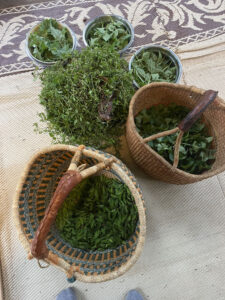
1) Garble your greens, as above.
2) Prepare a pot of boiling water that has been salted. You want to add about 1 tablespoon of salt (non-iodized salt, like sea salt) to every 4 cups of water.
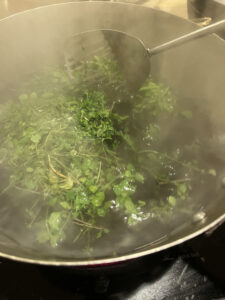
3) Blanch your greens for 1 minute, putting large handfuls in the boiling water, stirring briefly and then removing them and putting them in cold water or ice water to stop the cooking. You will notice how bright green and beautiful the brief cooking makes the greens!

4) Squeeze as much water out of them as you can. Then, ball up and freeze for future use.

I prefer this method strongly to drying the wild greens. Many of these greens do not retain their flavor or nutrition long-term. My one exception to this is Stinging Nettle, but I prefer dried nettle for tea and blanched nettles for food purposes.
Options for Cooking
There are many different ways you can use spring greens–either fresh or ones you’ve blanched and frozen for later use. Spring greens can be used in place of kale, spinach, mustard greens or related green foods in any dish that calls for them. Here are a few of my favorite ways to cook them:
- Soups: Add spring greens to the soup to increase nutritional value. They can be added to many different kinds of soup—I typically add them in the last 5-7 minutes of cooking time.
- Garnish: Spring greens can be sliced up and added as a garnish to any dish. Chop them up and sprinkle over meats, vegetables, rice, or pasta.
- Stir Fry: Spring greens can be added in the last few minutes to any stir fry or pan-based dish you are preparing with meats, veggies etc. If you have a lot of bitter greens, I find that adding a bit of sweet (brown sugar, honey, maple syrup) can really balance out the bitter flavors. And remember–bitters are medicinal!
- Sauces: Add spring greens to your sauces at the end of cooking time.
- Salads: Spring greens are wonderful as a salad (all except the Nettles!). My favorite for this are violet greens and all heal.
- Hummus: Spring greens are great in hummus. I will steam them for 3-5 minutes, then add them to the food processor with other hummus ingredients (1 can chickpeas, 3 tbsp tahini, 2-3 cloves fresh garlic; salt to taste, 2 tbsp olive oil is my base recipe)
Spring Green and Noodle Stirfry

Here’s a recipe I developed to enjoy spring greens! I use this recipe a lot for demos. You can also add meat and/or tofu or other veggies.
| Ingredients
· 2-3 cups of spring greens, washed and chopped · 2-3 tbsp water · 1 tbsp olive or sesame oil · 1-2 packages of rice or wheat Asian noodles (you can use any kind of noodle: soba, ramen, and more. You will want 2-3 servings of noodles) · Mustard sauce |
Mustard Sauce: Combine all ingredients:
· 2 Tablespoons stone-ground mustard · ¼ cup Soy Sauce, Tamari or Bragg’s Liquid Aminos · 2-3 Tbsp honey or brown sugar · 1 Tbsp rice vinegar (or substitute white vinegar)
|
Cook your noodles fully, strain, and toss in oil to prevent sticking, and set aside. In 2 tbsp of water, simmer spring greens in your pan or work 3-4 minutes (with a lid on) until they are cooked. Add mustard sauce and noodles, and cook for 2 more minutes until sauce is incorporated. You can also add any cooked meat or vegetables to this recipe.
Conclusion
I hope you enjoyed this overview of spring green harvesting! My suggestion to get started is to start by identifying a few really abundant plants in your ecosystem (like Garlic Mustard!) and then build your knowledge and confidence slowly. Where I live, there are enough spring greens that we can enjoy these daily for months, and all of the harvesting we are doing is also doing double-duty in removing opportunistic plants from the ecosystem or getting our garden beds ready for planting.
I would love to hear stories about how you have worked with and incorporated spring greens into your life! I would also love to hear any recipes that you have for working with these amazing and abundant plants.
Druid’s Garden Blog on Break! Please note that I will be taking about a month off from blogging. We have the final MAGUS gathering coming up, and I am always very busy with the gathering as well as getting in our annual gardens this time of year. I’ll see you again in late May or early June! Blessings.


browsing on violets has long been a habit of mine, unable to resist. very nice overview of the season.
Yes! I love violets–both flowers and leaves. My geese do not love violets, so there are always a lot of them in our meadows where they graze grass, dandelions, chickweed and more.
Hi Dana, this is Hazel Kent, always love your blog posts and thoughts about the world! I’ve remembered for a while your writings about Czechia. I also got the opportunity to go there once and loved it. I’m able to go again and was wondering if there are any places in particular you might recommend an herb/ magic person visit. I member that you went to Radagast’s mountain and saw the big clock in Prague, right?
Hi Hazel,
Yes! I love Radhost mountain – that’s in Eastern Czechia, near Ostrava. There are a lot of really cool Labyrinths in that area too (you can find many here: https://labyrinthlocator.org/world-wide-labyrinth-map/).
In Prague would very highly recommend Speculum Alchemae (http://www.alchemiae.cz/en). They can point you to some other magical sites of interest. If you are interested in astrology and astronomy, there’s the astronomical clock, Kepler’s house, and even the grave of Tycho Brahe in a nearby church.
The other place that is incredible is the Botanical garden at Charles University – you need cash to get in. https://cuni.cz/UKEN-1642.html
You can spend half a day or more and it is one of the most fine gardens I have ever been in! Enjoy 🙂