 Dana O'Driscoll
 Anyone who follows a nature-based spiritual path is often interested in the different ways that the land offers food, shelter, medicine, and more. One of the ways that I’ve deepened my awareness and connection to nature is through the practice of herbalism. Herbalism is a wonderful practice because it is a path of connection and wisdom surrounding your local ecosystem (at least the way I practice and teach it). But, those newer to herbalism often wonder what the best approach is to learn herbalism: there’s medicine making, body systems, botany, energetics and tissue states, herbal contraindications, holistic health, and so many other areas. A foundation of any herbal practice is wisdom about plants: where and how they grow, when their medicine is most potent, their actions, how they taste, and their energetics. You can know a great deal about the other areas I listed, but without the basic knowledge of plants—none of the other areas of learning matter as much. In this post, I’ll offer a comprehensive introduction to getting to know medicinal plants, herbs, and trees using the framework of the Four I’s: Intellect, Instinct, Intuition, and Imagination.
This post is part of my herbalism series of posts, where I share practical advice about being a locally-based, herbalist weaving magic, intention, and connection to nature. I think reclaiming our own health and connecting to the land to support our health is one of the ways we can help shape the future and bring in a better paradigm for all, and that’s why I’ll keep writing on herbalism and healing plants. For me personally, I tried a lot of different ways to teach about nature connection in my local community (rural, Western PA) and the one that people really kept gravitating to was herbalism and foraging–so that’s how I teach people about returning to nature locally! And let’s not forget that in may places in the world, people have poor access to healthcare (unaffordable, little access to high-quality healthcare providers, etc.) This is the case where I live–we have about 50% less providers than we did pre-pandemic, very long wait times, and the care has become unaffordable. Thus, this may be a path that more an more people need to take up to help themselves and their community. With that said, for all of my writings on herbalism on the Druid’s Garden blog, you can visit my Guide to Herbalism and Magical Herbalism. You may also be interested in learning more about my Plant Spirit Oracle deck and book set (which contains extensive information on herbs and herbal preparation as well as working with herbs metaphysically and physically) and my TreeLore Oracle, which offers information on herbalism, botany, human uses, and metaphysical qualities of trees from Eastern North America. And with that, let’s dig in!
How do I decide what herbs to study first?
There are so many ways that you can build herbal wisdom, and building it one herb at a time is a tried and true method. Learn about the herbs first that can do the most good in your life and in the lives of your family. For many people, this includes herbs that can assist with the most common conditions that people experience—and I’m also listing a few herbs for each that might stimulate your own curiosity to learn more.
- Supporting a healthy gut and digestive tract: catnip (Nepeta cataria), chamomile (Matricaria chamomilla or Chamaemelum nobile), fennel (Foeniculum vulgare), ginger (Zingiber officinale), mint (Mentha spp.)
• Supporting the nervous system: cannabis (Cannabis sativa), nettles (Urtica dioica), oat straw (Avena sativa), passionflower (Passiflora incarnata)
• Relieving sore and achy muscles: black birch (Betula lenta), goldenrod (Solidago spp.), willow (Salix spp.)
• Addressing wounds, cuts, bruises and bites: calendula (Calendula officinalis), chickweed (Stellaria media), comfrey (Symphytum officinale), plantain (Plantago major or Plantago lanceolata)
• Supporting the body’s elimination systems: burdock (Arctium lappa), cleavers (Galium aparine), yellow dock (Rumex crispus)
• Supporting a healthy immune system and recovering from cold/flu: boneset (Eupatorium perfoliatum), echinacea (Echinacea purpurea or Echinacea angustifolia), elder (berry, flower) (Sambucus nigra), oregano (Origanum vulgare)
Obviously, no list can be exhaustive. But you can see how saying to yourself, “what could I use help with now?” can help you narrow down a list of herbs to start learning about. Lean into your own needs and the needs of your family, as that will help motivate you to get started!
The Four I’s
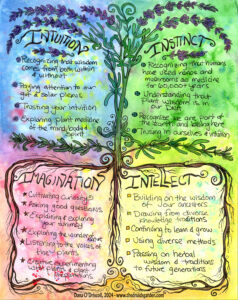
These four I’s are taught within my herbal lineage of Traditional Western Herbalism—Matthew Wood has one set of three, and Jim McDonald has a slightly different set of three, but I like the four together, and so that’s how I use them. As I see them, the four I’s are:
- Intellect: This is both book knowledge and drawing upon resources (teachers, books, classes) to learn and grow your knowledge.
- Instinct: Herbalism pre-dates human history, dating back at least 60,000 years. We have a great amount of plant wisdom in our DNA. Trust your instincts when it comes to plants!
- Intuition: Intuition asks us to tune in closely with our bodies: our sense of taste, touch, smell, sight, and hearing. Often, when we encounter or ingest plants, we have many subtle clues that can help us understand if a plant will be good medicine for us.
- Imagination: This is where our curious mind comes from: both in terms of asking good questions and cultivating curiosity (I wonder what a brew would taste like cold infused vs. hot infused?) but also creative experimenting with plant and plant preparations.
Now, let’s walk through each of these and think about how we might connect with these healing plants.
Intellect: Learning about Herbs through Books, Classes, and Human Knowledge
Often times, a useful way to start to learn about herbs is learn about the existing knowledge around herbs. Knowledge about herbs comes from many places: from traditional uses observed by herbalists and passed down for thousands of years. This is the herbal wisdom that many of us tap into and draw upon when we are reading herbal books or learning from our teachers. In some cases, you can also explore the scientific research on a specific herb or mushroom (which is not present on many herbs but is available for many mushrooms and more popular herbs in TCM or Ayurveda). You can also take classes or learn from herbal teachers—herbalists like to teach with a combination of traditional knowledge, scientific knowledge, and storytelling.
Things you might want to learn about your herb include:
- What is the name and Latin name of the herb?
- Where does the herb typically grow, when is it in season, and what does it look like?
- What parts of the herb should be turned into medicine, and what kind of preparations work best?
- What are the actions of the herb? (* see my note below). That is, how does the herb affect the human body? Does the herb have a special affinity with any specific body parts or conditions?
- Are there any contraindications for this herb? Some herbs may interfere with pharmaceutical medication or may need to be avoided during pregnancy.
- How strong is this herb and what are the typical doses that people use?
Some sources of information are better than others, especially in the age of AI. I suggest using books, classes, and teachers to seek herbal wisdom, or explore websites of reputable herbalists or herb schools. Purchase and have in your herbal libraries a few different Materia Medica books (these are books that list herbal uses, such as Matthew Wood’s Earthwise Herbal (Vol 1 & 2) or Michael Tierra’s Way of Herbs). You can also access Grieve’s Herbal which is an older but still very good Materia Medica free online;. In addition, I recommend two medicine-making books that also cover herbs and dosage: Green’s Medicine Makers Handbook and Cec’’s Making Plant Medicine. These are invaluable for learning herbalism.
However, I have a word of caution about finding herbal information online. Avoid search engine searches, especially avoid AI-generated results, and avoid mainstream health or hospital websites (which are usually the top 20 or so results). Why? Most AI-generated search results and the first page or two of search terms lead to hospital websites or big sites, and those sites do not employ herbalists to write, they offer very shallow information, and they do not approach herbs from a holistic and herbal perspective. At best, they drastically oversimplify what herbs do and how they work. At worst, they leave out critically important information that is necessary to use the herb, including the energetics of the herb. Getting the wrong information or getting very simplistic information can actually be detrimental to your long-term learning. Herbalism and herbal actions are all about nuance, and most searches and big websites don’t convey any of the nuance.
Once you have your sources and are starting to work through the questions above, try to base your understanding of the herb off of a few sources and compare how they discuss the herb. Recognize that different sources may be working from a different foundation (e.g. I am a Traditional western Herbalist and locally-baed folk herbalist, but someone else may be practicing Ayurveda, and those are different thinking systems).
*This is one area that can be overwhelming. Most herbalists work with an energetic and thinking system: I use Traditional Western herbalism, others may use Ayurveda, Traditional Chinese Medicine, or other approaches. In Traditional Western Herbalism, you can break these into actions with increasing specificity to understand an herb. We have foundational actions–what we sense when we engage with the herb and its effect on the body: bitter, demulcent, astringent, aromatic, relaxant, stimulant. Then we have Primary Actions: the key action on the body: is it an alterative, diuretic, expectorant, adaptogen, trophorestorative, laxative, lymphatic, nervine? Finally, we have secondary actions (which may be anti-inflammatory, anti-cancer, or antimicrobial). This is a lot, but as you learn, you pick up more and more of this system as you go. A good intro is either Jim McDonald’s Lindera course (he now offers an online version) or Matthew Wood’s Traditional Western Herbalism Book. If you are in Western or Central PA, maybe you’d want to study with the Pennsylvania School of Herbalism (we primarily do in-person teaching).
Instinct: Recognizing the Herbal Human Legacy and Connecting with Herbs

While learning with your intellect takes time, it is only one aspect of how to learn about herbs. In Western society, we often privilege only intellectual ways of knowing, and this lack deeply affects our ability to not only have “book knowledge” but also lived experience. By leaning into our human instincts and our own intuition, we can build more holistic and comprehensive ways of learning about herbs. Our own experiences and bodies are critically important to knowing herbs.
When I talk about instinct, I think about it in a few ways. First, I think about the relationship between our bodies and herbs on a subconscious level. We know that humans have been using herbs for at least 60,000 years, and we have ample evidence from everything from cave walls to frozen human remains from earlier points in history that herbs were used and carried regularly by humans (and even our pre-human ancestors). We also have this evidence integrated into our very DNA, for example, the endo-cannabinoid system is a complex network of enzymes, receptors, and neurotransmitters throughout our bodies that bind to cannabinoids, which regulate a wide range of bodily functions including sleep, mood, immune function, bone health, cardiovascular function, pain and pain perception, appetite, metabolism, memory, emotional processing, and more! Cannabanoids are produced by many plants, most notably Cannabis spp., but also Cacao, Echinacea, Kava Kava, and even Hops. In other words, our bodies literally evolved with these potent plants and need them for well-functioning.
This means that your body contains a wealth of knowledge, knowledge that you can tap into, if you just trust yourself and listen. Part of being an herbalist is recognizing that our bodies have a tremendous ability to signal to us what we need.
A simple activity to do is to walk through a forest, herb garden, or even someone’s apothecary and interact with the healing plants there. Which ones are you instinctively drawn to? Which ones feel “right” to you to interact with? Take time to learn about these and who you are drawn to.
Another way I like to think about instinct is the inherent patterns in nature–sacred geometry and the doctrine of signatures. These are patterns that we see again and again in nature, and these same patterns are reflected in the body. The Doctrine of Signatures tells us that when we observe a plant, we can see in the characteristics of the plant reflections on the healing quality of the plant. For example, Calamus / Sweet Flag (Acorus calamus) looks like a throat or larynx, and unsurprisingly, has actions there. So you can start to use your keen, very human observation skills and tie that with your gut knowing. More on the doctrine of signatures and other ways of reading plants on the landscape can be found here.
Intuition: Leaning Into Our Bodies and Body-Based Knowing
Once we start recognizing that part of learning about herbs is the move to integrate our minds into our bodies, we can use our bodies to “tune into” the herbs and use our bodies as sites to learn more. My very first herbalism class with Jim McDonald opened me up to this practice. Jim started by having us all drink a small cup of tea and simply observe how the tea affected us over about a 20 minute period. As a group, we watched people warm up, get up to pee, feel their digestion settle down, and simply observed the effect of the herbs on our bodies. This is a powerful practice and one you can do to substantially deepen your relationship with an herb. I use this a lot in my own teaching—and part of what it does is have us realize that as herbalists, part of what we have to learn to do is to trust our own bodies and our own intuition, recognizing that we know our bodies best and can learn about herbs through direct experience.
Step 1: Have a single-herb, simple preparation. You will want to have an herbal preparation typical to the herb in question: a tea, tincture, salve, even an herbal steam, infused vinegar, and so on. Take the herb in a common way.
Step 2: Get comfortable and start with a check-in with your body:
- How does your body feel right now? Note how each part of your body feels from your head to your toes. Note any places of tension or pain.
- How does your mind feel right now? Note if you feel alert, groggy, unsettled, or anything else.
- How does your heart and emotions feel right now? Do you feel happy, sad, heavy, weary, or joyful?
- How does your spirit feel right now? Do you feel l that you are fulfilling your purpose? Do you feel spiritually aligned and connected to the divine (however you conceive of it?)
You can jot notes down for each of these things.
Step 3: Now, consume your herbal preparation: the tincture, the tea, eat some leaves fresh, etc. Take a few moments to simply be with that herb and feel how that herb works on your body. Wait 5-10 min as you sit with the herb, and then do the check-in again. What has changed? Different herbs work on different parts of ourselves. Often, this is also where we can begin to ascertain an herbs actions on the body, mind, and spirit.
And now I’ll apply a little Traditional Western Herbalism thinking (for a nice overview, see this article by Kiva Rose): In terms of foundational actions: How the herb tastes and feels as you interact with it helps determine the foundational action of the herb. In Traditional Western Herbalism, we recognize the following six foundational actions: Bitter, Astringent, Demulcent, Stimulant, Relaxant, and Aromatic. Use your senses to really feel out the energetics of this herb.
In terms of primary actions: You can often also feel noticeable effects on your body, even in the short term, when you consume an herb. Maybe your stomach and gut relax and calm after you drink the tea, but soon you realize you have to pee! That suggests a possible carminative action combined with a diuretic action, for example. You don’t need all the terms: the herbal actions are based on the effects on the body. Not all effects are easily noticeable in this way as some have longer-term effects. But as you start to take your herb, you might start to notice more effects longer term (and keep notes as you are learning).
What does this kind of practice do? Tuning into your body and using your intuition to really lean into this practice can help you develop experiences that add to the intellectual knowledge you have. It helps you re-integrate your mind and your body into a deeper knowing, and allows you to recognize the power of your body and senses in being a good herbalist.
Imagination: Cultivating Curiosity and Staying Open to Wisdom
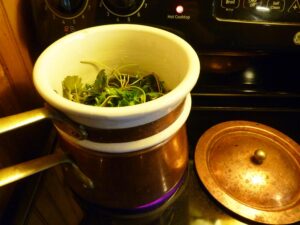
Our final category is imagination! Herbalists throughout time have learned new uses of plants and learned new healing plants and mushrooms through their own curiosity, applying their intellect, instinct, and intuition to explore plants, solve problems, and heal. Just like everything else in Western society, we are culturally disempowered to relegate our knowledge and actions to “experts.” But in the case of herbalism, it is vital that we take control of our own learning and learn how to learn, how to ask good questions, and be open to experimentation. This is, in part, because many herbal traditions have been lost, and we are in the process of rebuilding them, especially in North America.
As an example of experimentation using my imagination, last year we had a bumper crop of Spicebush (Lindera benzoin) which, I knew traditionally had been used for compresses and pain, but I had never used it in a topical, nor did I know anyone else who had. I read about topical use in an old book, and decided to try it out. I combined crushed berries (which smell amazing) over low heat with black birch (budding twigs), goldenrod (leaf), and some kava kava. The results were fantastic—the Spicebush added a subtle warming sensation and a beautiful color and smell, and balanced nicely with the other herbs. I would never have known this if I hadn’t tried it out!
Learning about herbs is all about curiosity and imagination. You’ll never know unless you try. What you can see from my example is that I combined the other I’s to formulate a good question that could be explored through my own curiosity.
Conclusion: Getting to Know herbs
One of the things that always amazes me is how much herbal wisdom is right outside of my door. I love stepping outside and being drawn to a plant I don’t know or don’t know well, and seeing that opportunity as a chance to learn, connect, and heal with and through nature.


